













Google's GenCast Revolutionizes Weather Forecasting with AI
Google DeepMind unveiled GenCast, an ensemble AI weather model that predicts conditions 15 days ahead and outperforms the world's top operational system in 97% of test scenarios. The model builds directly on the GraphCast architecture published last year.
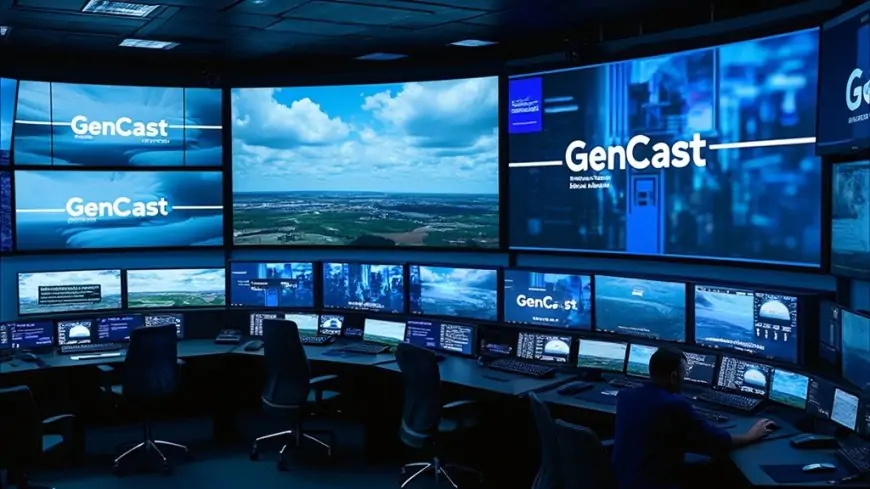
Google DeepMind has released GenCast, a second-generation AI weather model that pushes medium-range forecasting from 10 days to 15 days and outperforms the European Centre for Medium-Range Weather Forecasts’ ensemble system on 97.2% of evaluated targets. The announcement, made on December 4, positions AI-driven meteorology as a serious operational tool rather than a research curiosity.

GenCast is a direct evolution of GraphCast, the model DeepMind published in Science last year and open-sourced for meteorological agencies worldwide. Where GraphCast produces a single deterministic forecast, GenCast generates an ensemble—fifty or more individual predictions with slight variations in initial conditions, which together produce a probability distribution. This is how operational weather centers like ECMWF already work with their physics-based ensemble system, known as ENS. GenCast just does it faster and, in most cases, better.
GenCast outperformed ECMWF’s ENS on 97.2% of evaluated targets when running 15-day forecasts. The model is particularly strong at predicting extreme heat, high wind speeds, and tropical cyclone paths.
The architecture differs from its predecessor in one key respect. GraphCast uses a graph neural network that maps the planet onto a mesh of interconnected nodes. GenCast replaces this with a diffusion model—the same category of generative architecture that powers image and video generators like Midjourney and Sora. The model starts with a rough estimate of future weather and iteratively refines it, producing a crisp forecast that respects the physical constraints of atmospheric dynamics without ever being explicitly taught any physics equations.
Google trained GenCast on the same ERA5 reanalysis dataset that GraphCast used, covering four decades of historical weather data from 1979 to 2018. In testing, the model generated 15-day forecasts in about eight minutes on a single Cloud TPU v5. An equivalent ensemble run on a traditional supercomputer would take hours.
The release is also open. DeepMind published the model weights and code, and ECMWF and other weather agencies are already evaluating the forecasts. The practical implications are significant: when a cyclone is forming or a heat dome is building, getting an accurate probability distribution eight hours earlier than current systems allow means emergency managers can make decisions a full shift ahead. That is the difference between an orderly evacuation and a scramble.
GenCast does not make GraphCast obsolete. The two models are designed for different jobs: GraphCast for fast deterministic forecasts, GenCast for uncertainty quantification. Together, they represent the fastest-moving front in AI’s application to real-world science.