



























GraphCast Transforms Global Forecasting with Unprecedented Accuracy
Google DeepMind’s GraphCast model, published in Science last year, is now being tested live by ECMWF. The AI weather forecaster delivers 10-day predictions in under a minute on a single TPU, matching or beating the gold-standard HRES system on 90% of targets.
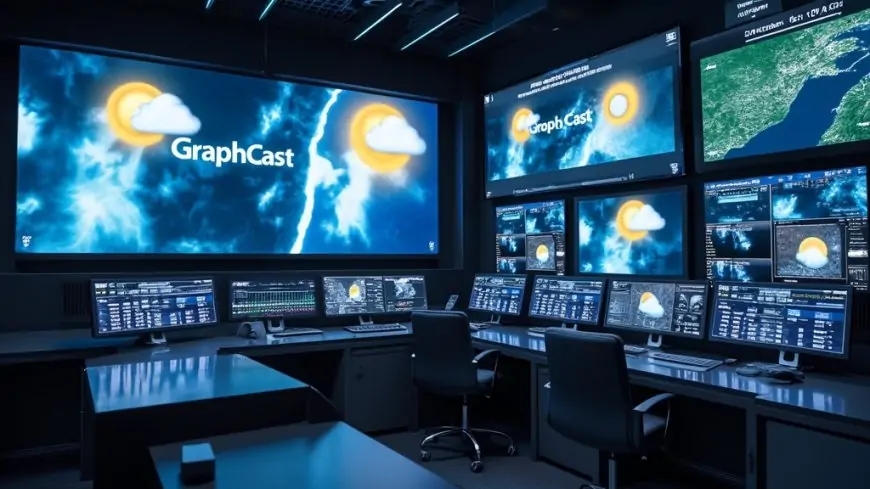
A year after its publication in Science, Google DeepMind’s GraphCast has crossed from research project into operational reality. The European Centre for Medium-Range Weather Forecasts is now running a live experiment of the model’s forecasts on its website, making this the most serious validation yet of AI-driven weather prediction outside a lab.

GraphCast works differently from the numerical weather prediction systems that have dominated meteorology for decades. Instead of coding physics equations into algorithms and running them on supercomputers, it was trained on four decades of historical weather data from ECMWF’s ERA5 reanalysis dataset. The model learned cause-and-effect relationships in how Earth’s atmosphere evolves without being explicitly programmed with any physics. The result is a system that generates a 10-day global forecast at 0.25-degree resolution—more than a million grid points covering the planet—in under a minute on a single Google TPU v4 chip.
Conventional systems like ECMWF’s High Resolution Forecast can take hours on supercomputers with hundreds of machines to deliver the same product.
GraphCast outperformed HRES on more than 90% of the 1,380 verification targets tested, including temperature, wind speed, and atmospheric pressure at multiple altitudes.
The model has also shown practical promise in predicting extreme events. It can track cyclone paths with greater lead time than traditional methods, identify atmospheric rivers linked to flood risk, and forecast the onset of extreme temperatures earlier than competing systems. These are the kinds of predictions that shift disaster preparedness timelines from hours to days.
DeepMind open-sourced the GraphCast model code, which has allowed meteorological agencies worldwide to evaluate it on their own data. The approach is built on graph neural networks, which turn the Earth’s surface into a mesh of interconnected nodes. Each node represents a grid point, and the model learns how weather conditions at one location influence conditions at another through these connections.
GraphCast is not a replacement for traditional forecasting. It was trained on ERA5 data, which is itself produced by a conventional NWP system that fills gaps in observational data. The two approaches are complementary: traditional physics-based models reconstruct the historical record that AI models then learn from. The question now is not whether AI will displace conventional weather forecasting, but how quickly the two can be integrated into a hybrid system that delivers both speed and physical consistency.