












































Nearly Half Of Enterprise AI Projects Are Expected To Fail
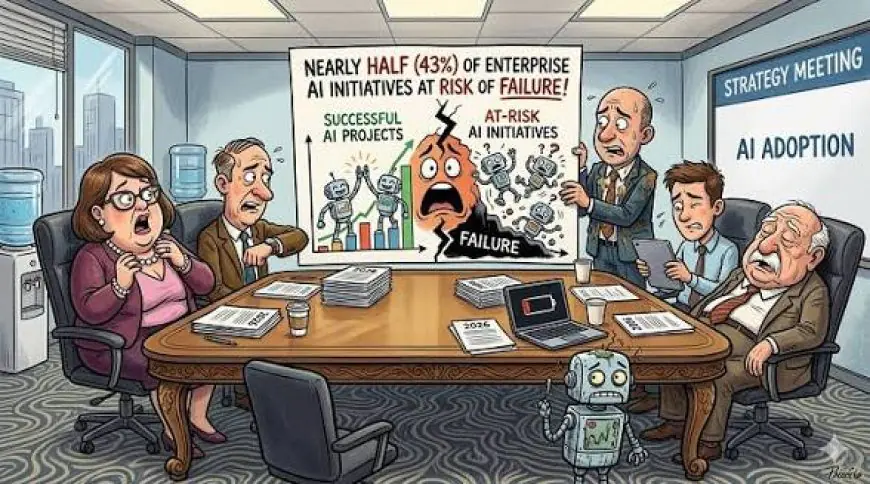
A new global report from HCLTech warns that 43% of major enterprise AI initiatives may fail despite massive corporate investment in artificial intelligence. The findings reveal that organizational misalignment, unrealistic ROI expectations, and execution pressure are becoming the biggest obstacles to successful AI adoption


The Enterprise AI Boom Is Facing A Reality Check
Artificial intelligence may be dominating boardroom conversations worldwide, but a growing number of companies are discovering that deploying AI successfully is far more difficult than expected. According to a major new global report released by HCLTech, nearly 43% of large-scale corporate AI initiatives are projected to fail, despite billions of dollars being invested into artificial intelligence infrastructure, software, and automation programs.
The findings, based on surveys involving executives from billion-dollar companies, point to a widening “execution gap” inside enterprise AI strategies. While businesses continue rushing to adopt generative AI and automation tools, many organizations are struggling to turn early enthusiasm into measurable business results.
Why AI Adoption Is Becoming More Complicated
For many companies, the problem is no longer access to AI technology. The market is already flooded with advanced AI tools, enterprise platforms, and automation systems promising to improve productivity and reduce operational costs. Instead, the real challenge appears to be execution, leadership alignment, and proving financial returns quickly enough to satisfy investors and executives.
The report highlights growing pressure on chief information officers and enterprise technology leaders to deliver clear ROI from AI investments within increasingly shorter timelines. Many organizations now expect major AI projects to generate measurable value within just 18 months, creating intense pressure on internal teams to move faster than their operational structures can realistically support.
Industry analysts say this pressure is exposing weaknesses inside many corporate environments where departments remain disconnected, workflows are outdated, and long-term AI governance strategies are still missing. Without strong coordination between leadership, operations, and technical teams, AI projects can quickly become expensive experiments rather than scalable business solutions.
The Hidden Costs Of Poor AI Strategy
One of the biggest issues identified in the report is organizational misalignment. In many enterprises, AI initiatives are being launched without fully restructuring workflows, employee training systems, or data management processes needed to support sustainable deployment. As a result, companies often encounter delays, inconsistent performance, and internal resistance that weaken project outcomes.
Experts also warn that unrealistic expectations fueled by the rapid rise of generative AI are contributing to the problem. Over the past two years, businesses across finance, healthcare, retail, and manufacturing have accelerated AI adoption plans in fear of falling behind competitors. However, many organizations underestimated the operational complexity required to integrate AI into existing systems at scale.
Additional insights into enterprise AI transformation strategies can be explored through the official IBM artificial intelligence resource center.
Why Companies Are Rethinking AI Investments
The growing concern over failed AI initiatives is already influencing how businesses approach future investments. Rather than pursuing broad AI deployments across entire organizations, many enterprises are beginning to focus on targeted use cases with clearly defined business outcomes. Companies are increasingly prioritizing efficiency improvements, cybersecurity automation, predictive analytics, and customer service optimization where ROI can be measured more effectively.
Technology leaders are also emphasizing the importance of workforce readiness as AI adoption expands. Successful implementation now depends not only on software capabilities, but also on employee training, governance frameworks, and executive alignment. Without those foundations, even advanced AI systems may struggle to produce meaningful long-term value.
Despite the challenges, enterprise AI spending is still expected to grow significantly over the next several years. Analysts believe the current wave of failures may ultimately force businesses to adopt more disciplined and sustainable AI strategies rather than abandoning the technology altogether.
More information about enterprise digital transformation and AI implementation trends is available through the official Gartner AI insights platform.