





































How UCLAs Light Powered AI Detects Deepfakes With Nearly 98 Percent Accuracy
UCLA researchers have built a hybrid digital-analog system that uses a programmable light modulator to analyze up to 15 videos simultaneously in a single optical pass, detecting deepfakes with nearly 98% accuracy while using far less energy than conventional electronic detection systems.
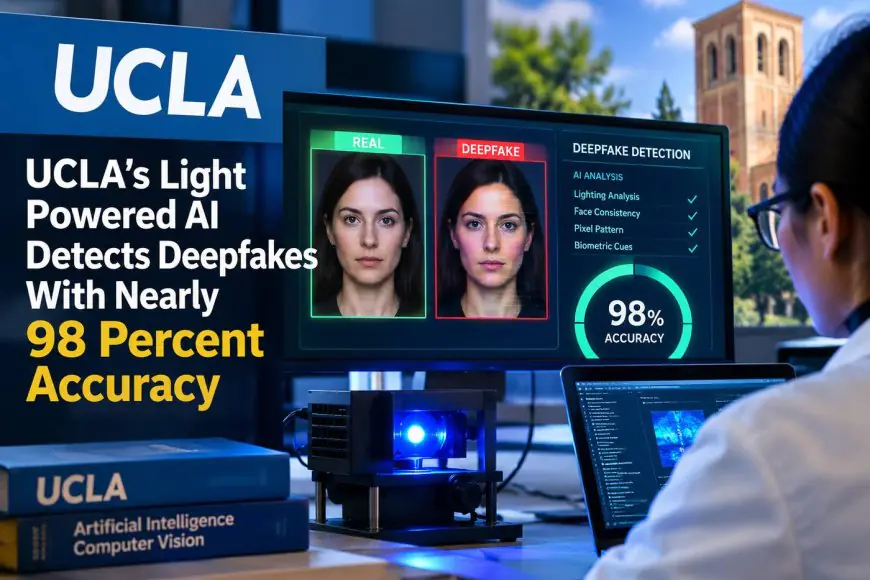
UCLA engineers just built a deepfake detector that does its thinking with light instead of electricity, and it's catching fakes faster than conventional systems while using a fraction of the power.


The research, led by Aydogan Ozcan's lab, combines a "lightweight digital front-end" with a spatially multiplexed optical decoding back-end, routing video data through a programmable spatial light modulator rather than relying purely on electronic chips.
What makes the design genuinely different is the parallel processing trick at its core: instead of analyzing one video at a time, the system passes multiple video streams through the optics simultaneously in a single optical computation. A few numbers from the published results define how well it actually performs:
- Testing on the Celeb-DF video dataset, the system achieved average deepfake detection accuracy of 97.79%, with sensitivity of 99.86% and specificity of 95.72%
- Researchers processed 15 videos in parallel within a single optical pass per inference, spanning classical face-swapping, real-world deepfake recordings, and fully AI-generated video
- Because the heavy lifting happens optically rather than through repeated digital computation, the architecture is designed to scale with substantially lower energy demands than purely electronic deep-learning detectors
The energy and speed advantages matter because of where this technology is headed next: as generative video tools make convincing fakes cheaper and faster to produce, detection systems that can't scale economically risk falling permanently behind.
UCLA's approach also claims stronger built-in resistance to adversarial manipulation, since attackers optimizing against conventional digital classifiers would need an entirely different strategy to fool an optical decoding stage.
The research remains an academic proof of concept rather than a deployed product — scaling a lab photonics setup into a commercial detection pipeline, and validating it against the kind of adversarially tuned fakes attackers would actually build to beat it, are the next hurdles standing between this result and real-world deepfake defense.