


































NVIDIA Hands Scientists a Free Chemistry Exam and an Open Model to Build Lab Agents
NVIDIA bundled its open Nemotron 3.5 Super VL model with a nearly 50,000 question chemistry dataset and training recipes for science agents. The partner results look strong, but every number comes from NVIDIA and its partners.
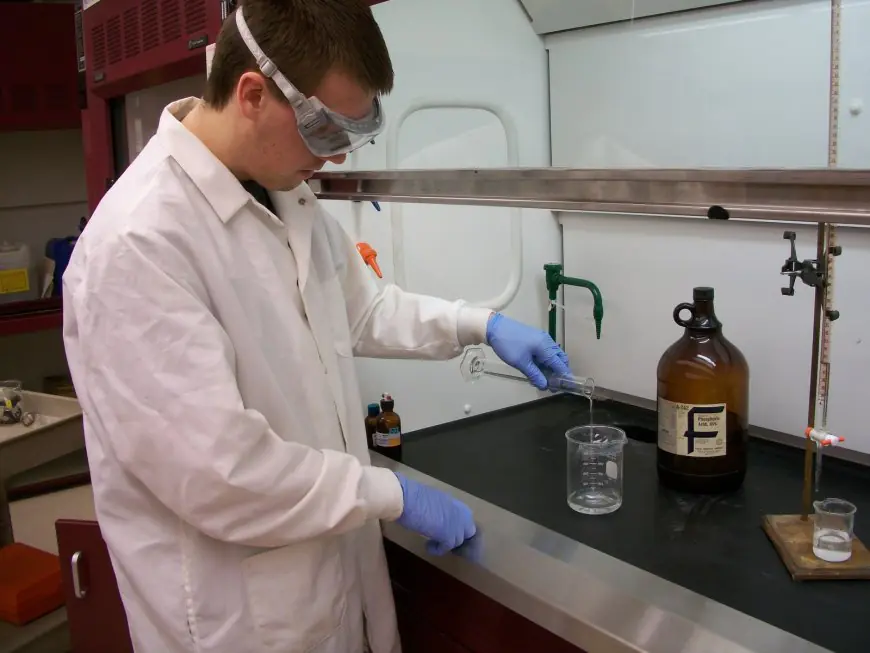
NVIDIA wants to be the default brain inside the world's science labs, and its pitch is that the brain is free. At the SC26 supercomputing conference in Chicago on Monday, the company introduced Nemotron for Science, a bundle that pairs its open Nemotron 3.5 Super VL model with a new chemistry dataset and post-training recipes meant to help researchers build their own specialized science agents.


Read the fine print and this is less a new model than a repackaging. Nemotron 3.5 Super VL was already on Hugging Face. Its model card lists it at 120 billion total parameters with 12 billion active, a context window of up to 1 million tokens, and the OpenMDW 1.1 license, which NVIDIA says allows commercial and non-commercial use. What is new is the recipes, the dataset, and a list of labs NVIDIA says are plugging it in.
The most concrete piece is LitmusBench v0.2, which NVIDIA describes as an open dataset of nearly 50,000 questions for training and evaluating chemistry reasoning in language models. The dataset card on Hugging Face gets more precise, listing 47,118 training questions and 2,056 test questions, built from the ChEMBL, ExpansionRx and Biogen datasets. NVIDIA says the questions draw on molecular properties and experimental drug discovery data, with the goal of helping models predict how molecules behave, including their solubility and how the human body processes them.
"Nemotron for Science gives researchers open models, scientific data and post-training recipes to build specialized agents that reason through scientific problems and use CUDA-X accelerated tools to turn ideas into discoveries." Ian Buck, vice president of hyperscale and high-performance computing at NVIDIA
Then come the scoreboards, and every number on them comes from NVIDIA or its partners rather than an independent audit. NVIDIA says Terray Therapeutics post-trained Nemotron to pull reactants, products and reaction conditions out of scientific diagrams, recovering about 76% of annotated reactions on the RxnScribe test. It says Lila Sciences used the model to design lab protocols for its automated labs, and that post-training with lab feedback nearly doubled accuracy on making quantum dots to 61%, beating GPT-6 Astra at 54% while costing 10 to 20 times less to run. Therna, according to NVIDIA, post-trained the model for mRNA therapeutic design and saw scientists prefer its explanations over the base model in 96% of comparisons.
The research centers add weight. NVIDIA says Argonne National Laboratory is integrating Nemotron into StructBioReasoner, a multi-agent system for designing and evaluating protein-based therapeutic candidates for cancer and other diseases. Jülich Supercomputing Centre and RIKEN are also on board. At KTH Royal Institute of Technology, NVIDIA says, an agent built on Nemotron fixed 81% of broken GROMACS molecular dynamics setups in one overnight run on a single DGX Spark, with each fix checked by GROMACS itself.
That last detail is the most honest one in the announcement. A simulation package confirming that a broken input file now runs is a verifiable win. A model that designs a better mRNA sequence or a cancer drug candidate is a much bigger claim, and nothing in the release says any of these agents has produced a validated drug or material yet. These are tools that help scientists plan, extract and debug, not machines running discovery programs on their own.
So why give all this away? Because NVIDIA does not need to sell the model. It sells what the model runs on. The company says Nemotron 3.5 Super VL was optimized to run locally on a 128GB DGX Spark, its own desktop machine, and the full precision weights on Hugging Face are listed for four H100s or two GB200s. Every lab that post-trains Nemotron on its private chemistry data is a lab building its workflow on NVIDIA silicon and NVIDIA software.
For researchers, that is not a bad deal. Open weights mean a lab can keep sensitive experimental data on hardware it controls instead of shipping it to a closed model provider, which NVIDIA pitches directly. A public chemistry benchmark also lets outsiders test the claims. The real test is whether labs outside NVIDIA's partner list can reproduce those numbers. Until they do, treat the scoreboard as marketing with an asterisk.