


































Anthropic IPO Filing Claims Claude Now Writes Over 90% of Its Own Code
Anthropic's S-1 says Claude wrote more than 90% of the code added to the company's codebase in September and that per-engineer code output is up over 45 times since 2024. Those are Anthropic's own unaudited numbers, and they come in a document built to sell stock.
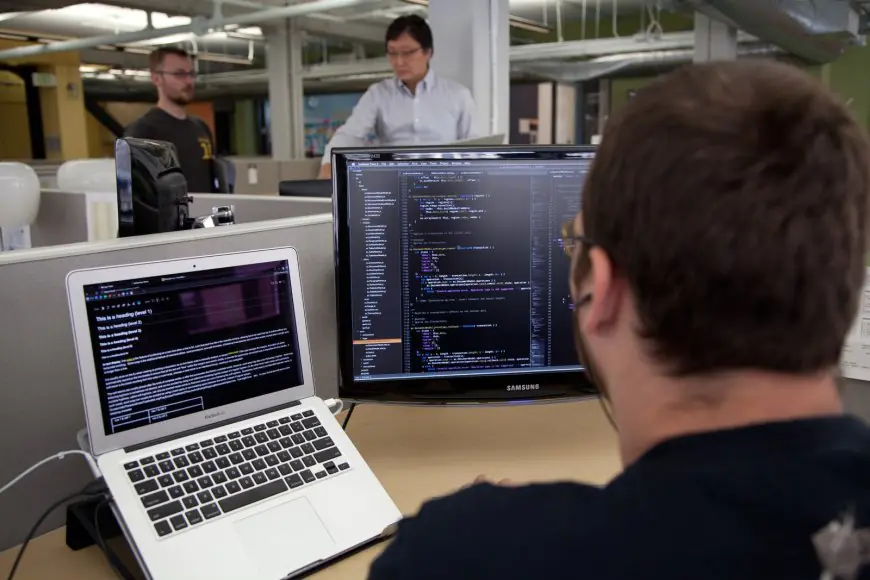
Somewhere in the hundreds of pages of Anthropic's IPO paperwork sits a sentence that would have read like science fiction three years ago. Claude, the company says, now writes almost all of the code that goes into Claude's own maker.


The claim appears several times in the Form S-1 Anthropic filed with the SEC on Monday. The financials in the same filing are a separate story. This one is about who, or what, is doing the work.
"Over 90% of the contributions to our codebase in September 2026 were written by Claude." Anthropic, Form S-1
The second number is even bigger. According to the filing, "the average daily volume of code contributed to our codebase per engineer in the three months ended September 30, 2026 was over 45 times the average daily volume in the year ended December 31, 2024."
Anthropic frames this as the payoff of what it calls "closing the loop," a recursive setup in which each generation of Claude helps build the next. The S-1 says Claude "has helped write and iterate on compute multipliers that are central to efficient inference and has accelerated development and model release timelines." Its engineers, the filing says, "increasingly direct and review its work rather than write code line by line."
A lean company that keeps hiring
The headcount numbers complicate the story of a company running on autopilot. Anthropic says its staff grew from about 940 at the end of 2024 to about 5,300 by September 30, 2026, a more than fivefold jump. That's not a company replacing people with its own product. It's a company hiring fast while handing its keyboards to a model.
The S-1 instead pitches efficiency per head. Anthropic puts trailing 12 month revenue per employee at over $6.6 million, up from $1.4 million a year earlier. Employees, known internally as "Ants," according to the filing and CNBC's live coverage, lean on the model everywhere.
"Ants use Claude across every function to take on work that would otherwise require substantially larger teams" Anthropic, Form S-1
The company calls itself "one of the most intensive users of our own technology." The question is what these numbers actually measure.
Start with the 90%. The filing never says what counts as a "contribution." Is it a line of code, a commit, a pull request? A model churning out boilerplate and tests racks up contributions far faster than a human solving one hard design problem. Ninety percent of the volume is not the same as 90% of the thinking, and the S-1 does not claim it is.
The 45x figure has the same weakness, only louder. Code volume is one of the oldest bad productivity metrics in software. More code can mean more features. It can also mean more to review and more places for bugs to hide. A 45x jump in output, with the review burden landing on the same engineers, deserves a hard look, not a victory lap. Anthropic itself has been pitching Claude as a code checker as well as a code writer, as in its recent claim that Claude found bugs that survived trillions of tests, which hints at how much checking all that machine output needs.
Then there's the venue. An S-1 is a legal disclosure document, but it is also a sales pitch to investors, and Anthropic sells Claude Code. A figure showing its product doing nine-tenths of its own engineering is the best advertisement the company could write. Nothing in the filing indicates these internal metrics were checked by an outside party. In its risk factors, Anthropic concedes that several of its operating metrics, including Claude's success rate, "have not been independently verified by third parties." Its separate claim that Claude's success rate on hard engineering problems reached about 90% rests on "internal benchmarks developed and maintained by us."
None of that makes the numbers false. But Anthropic is asking public market investors to price a company partly on the idea that its AI is already building its future products. Investors should want to know exactly how those contributions are counted before buying that story at IPO prices.