

































Meta's Large Concept Models Revolutionize AI with Enhanced Semantic Understanding
Meta introduces Large Concept Models (LCMs), a groundbreaking alternative to traditional LLMs, focusing on high-level concept processing for improved efficiency and multilingual capabilities.
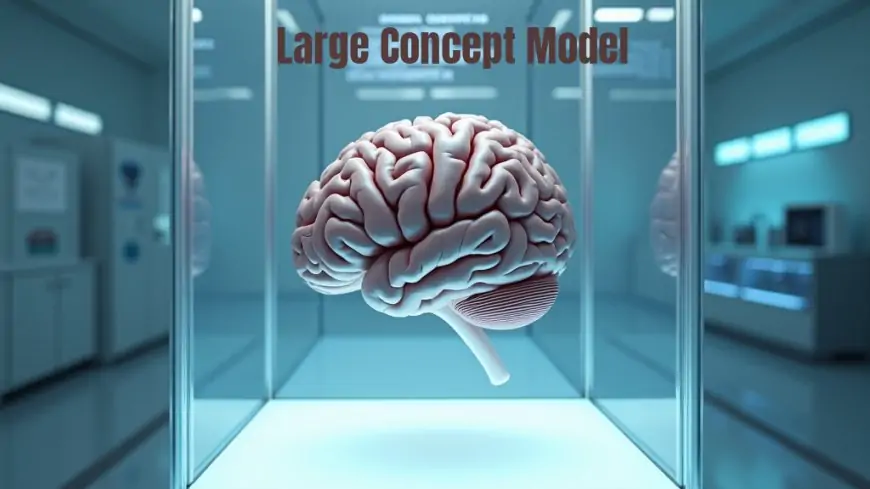
Meta has recently unveiled its innovative Large Concept Models (LCMs), a significant advancement in artificial intelligence that diverges from traditional Large Language Models (LLMs). Unlike LLMs, which predict words sequentially, LCMs operate on entire concepts or sentences, enabling a more holistic understanding of language. Meta's SONAR embedding method allows LCMs to function effectively across multiple languages and modalities.

LCMs are designed to predict high-level ideas rather than individual tokens. This allows for a more natural representation of language that aligns with human cognitive processes. The SONAR architecture supports the representation of concepts in a high-dimensional embedding space. This design is modality-agnostic and can handle over 200 languages, enhancing the model's versatility.
LCMs utilize a unique diffusion process that adds noise to inputs to clarify understanding. This approach is akin to refining a blurry image until it becomes clear, allowing the model to discern true meanings from noisy data. By adopting a hierarchical architecture, LCMs can maintain coherence in long-form content and facilitate local edits without disrupting the overall narrative flow. This structure mirrors human reasoning and enhances content generation quality.
The model offers several advantages over traditional LLMs. LCMs demonstrate superior computational efficiency when processing longer texts compared to traditional token-based models. This is achieved by reducing sequence lengths and addressing the quadratic complexity often associated with standard Transformers. The model showcases impressive zero-shot generalization capabilities, allowing it to perform well on unseen languages and tasks without additional training. Initial experiments suggest that LCMs produce more coherent and well-structured outputs than their LLM counterparts, particularly in tasks requiring complex reasoning or summarization.
The implications of LCM technology are vast, particularly in areas such as global communication, content creation, and AI research. The ability to seamlessly translate and process information across languages makes LCMs ideal for international applications. Marketers and content creators can leverage LCMs for generating engaging narratives and summaries that resonate with diverse audiences. The research community stands to benefit from the insights gained through LCM development, potentially leading to further advancements in AI models.
As Meta continues to refine this technology, the Large Concept Model represents a promising evolution in artificial intelligence, paving the way for more intuitive and efficient interactions between humans and machines. The transition from word-by-word prediction to concept-based understanding marks a revolutionary step forward in the quest for advanced machine intelligence.