










Nvidia And Cadence Expanded Their Robotics AI Partnership To Power The Physical AI Revolution
Nvidia and Cadence Design Systems have announced a major expansion of their strategic partnership, focusing on the development of "Physical AI." By integrating Nvidia’s Omniverse and Isaac platforms with Cadence’s industry-leading EDA tools, the collaboration aims to accelerate the design, simulation, and deployment of autonomous robots and industrial automation systems worldwide.
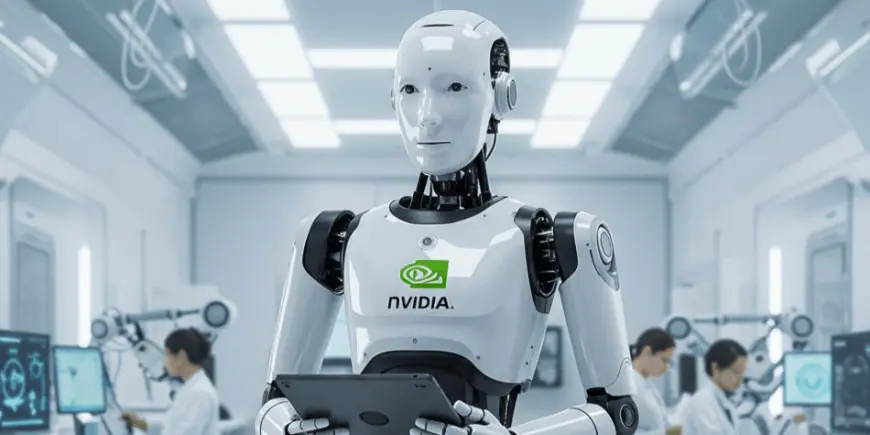


The tech world is currently witnessing a strategic pivot from "Digital AI"—the world of chatbots and code generation—to "Physical AI," where intelligence is embedded into machines that navigate the real world. Leading this charge are two titans of the silicon era: Nvidia and Cadence Design Systems. The companies have announced a deepening of their long-standing partnership to build the end-to-end infrastructure required for the next generation of robotics. This collaboration ensures that as the world moves toward humanoid robots and autonomous factories, the tools used to design them are as sophisticated as the AI driving them.
The timing is significant. As of April 2026, the industry has realized that training robots in the real world is too slow, too expensive, and often too dangerous. The solution lies in high-fidelity simulation—creating "Digital Twins" so accurate that a robot can learn a thousand years' worth of movement in a virtual afternoon. By combining Nvidia’s Omniverse and Isaac robotics platforms with Cadence’s Electronic Design Automation (EDA) and system design tools, the duo is creating a seamless "sim-to-real" pipeline that could slash development times for robotics startups and industrial giants alike.
The Convergence of Simulation and Design
The core of the expanded partnership centers on the integration of Cadence Reality Digital Twin technology with Nvidia’s computing stack. This allows engineers to design the physical hardware of a robot—the chips, the sensors, and the mechanical actuators—while simultaneously training the AI models that will control them. In the old workflow, hardware and software were developed in silos; in the new Nvidia-Cadence paradigm, they are co-designed in a shared virtual environment.
“Physical AI is the next great wave,” Nvidia CEO Jensen Huang noted during a recent industry summit. “To build these autonomous machines, we need a digital refinery where we can simulate physics with incredible precision.” Cadence’s role is critical here: they provide the underlying physics engines and thermal analysis tools that ensure a robot designed in a simulation won't overheat or suffer a mechanical failure when it hits the factory floor. According to Nvidia’s latest technical briefings, this integration is already being piloted by major automotive and aerospace manufacturers to optimize warehouse logistics.
Why "Physical AI" Is the New Frontier
While the 2024-2025 period was defined by Large Language Models (LLMs), 2026 is becoming the year of Large Behavior Models (LBMs). These are AI systems that understand spatial relationships, torque, and tactile feedback. For Nvidia, this partnership secures its position as the primary "foundry" for AI intelligence. For Cadence, it elevates its software from a chip-design tool to a foundational pillar of the global robotics economy.
The financial stakes are astronomical. The industrial robotics market is projected to reach hundreds of billions of dollars by the end of the decade, but the bottleneck has always been the "intelligence gap." By providing a unified platform, Nvidia and Cadence are lowering the barrier to entry for companies building everything from autonomous delivery drones to robotic surgeons. As reported by Cadence Investor Relations, the focus is on "system-level" innovation, ensuring that the electrical, mechanical, and AI components of a robot work in perfect harmony.
Impact on Global Supply Chains and Manufacturing
The ripple effects of this partnership will be felt most acutely in the manufacturing sector. "Sovereign AI" initiatives in regions like Europe and Asia are increasingly looking toward automation to solve labor shortages and bring production back to domestic soil. The Nvidia-Cadence stack provides the "blueprint" for these automated facilities. By using AI to design AI-driven robots, the cycle of innovation is becoming self-accelerating.
Furthermore, the partnership includes new tools for Custom Silicon. As robotics companies move away from generic chips to specialized "AI-at-the-edge" processors, Cadence’s EDA tools optimized for Nvidia’s Blackwell and future architectures become indispensable. This ensures that the specialized chips inside a robot’s limb can process data with the same efficiency as a data center GPU, but at a fraction of the power consumption.
The Roadmap for 2027 and Beyond
Looking ahead, the partnership is expected to expand into bio-robotics and autonomous infrastructure. The goal is to create a world where the physical environment itself is "intelligent"—where buildings, roads, and machines communicate through a shared digital twin framework. For now, the focus remains on the "Physical AI" of robots, turning the static machines of the 20th century into the autonomous coworkers of the 21st.
As the "Office Copilot" era matures, the "Robotics Copilot" era is just beginning. By securing the design and simulation layer of this transition, Nvidia and Cadence have effectively positioned themselves as the landlords of the physical AI revolution. For competitors and collaborators alike, the message is clear: the future of AI is no longer just on your screen—it’s moving into your world.