






































Scientists Build Octopus Inspired Smart Skin That Could One Day Obey AI
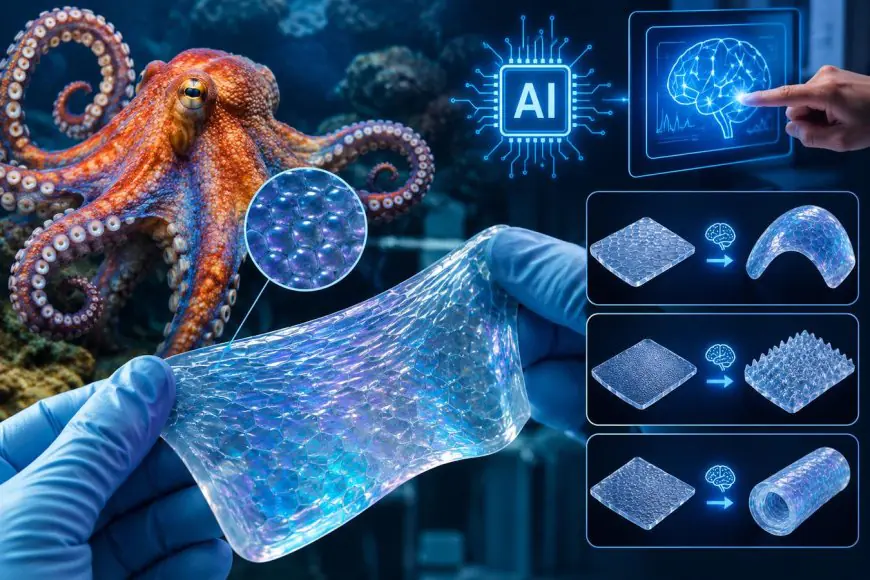
An octopus can vanish against its surroundings in the blink of an eye, coordinating color, texture and shape all at once — a trick engineers have spent years trying to copy in synthetic materials. A Penn State team led by Hongtao Sun built a programmable hydrogel they call "smart synthetic skin," using a technique called halftone-encoded 4D printing to embed digital instructions directly into the material's internal structure.


The printing method works by translating image and texture data into binary patterns baked into the hydrogel itself, rather than relying on added layers, ink or pigment. A few details show how the material actually performs:
- The team encoded a photo of the Mona Lisa into the skin, demonstrating it can hide and reveal encrypted visual information on command
- Exposed to triggers like heat, solvents, or mechanical stress, the single-layer sheet can morph from flat into domes, saddles, and textured cephalopod-like surfaces
- Sun described the core achievement as controlling "what it looks like and how it deforms, all within a single, soft material" — something prior shape-shifting materials typically needed multiple layers to accomplish
The AI piece is still aspirational rather than built. Sun has said the team wants to eventually layer in computer vision and neural networks so the skin can "compare the skin and its background, then automatically modulate it to match in real time, without human intervention" — true adaptive camouflage, not manual programming.
For now, every pattern the material displays is encoded during printing rather than decided autonomously, meaning the leap from a precisely scripted hydrogel to one that reads its environment and reacts on its own remains the genuinely hard problem still ahead of this research, not a feature it has already solved.