










































Claude Designed 17 Scorpion Toxin Binders in Just 64 Hours and Why It Is Not an Antivenom Yet
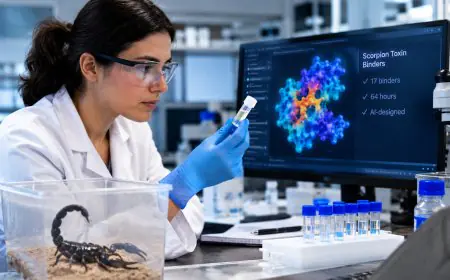
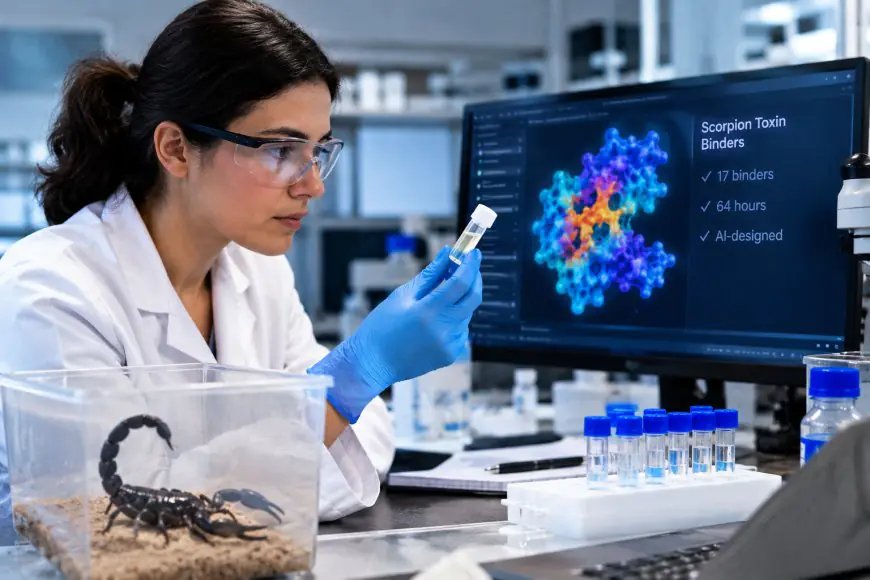
Anthropic reports that Claude generated 318,484 protein designs in 64 hours to target scorpion neurotoxins. Outside labs confirmed that 17 of 211 tested designs bind. The binders are an early step toward a possible antivenom, not a working cure.
Scorpion stings sound like a minor hazard until you look at the numbers. Anthropic says they hit at least 1.2 million people every year and kill more than 3,250, mostly children living where medical care is thin. Now the company reports that Claude spent 64 hours designing proteins that could one day help change that.


Working with Citrini Research, Anthropic asked an internal research version of Claude to build minibinders, which are small proteins made from scratch to stick tightly to one target.
Claude picked its own toxin structures, used 12 design tools, generated 318,484 candidates and screened 553,052 design-toxin pairs. It then shortlisted 180 designs, and the team added 31 more with Claude's help. Humans stepped in with only four follow-up prompts, although the run still consumed roughly 10,000 GPU hours.
Two outside labs, Adaptyv Bio and Twist Bioscience, tested all 211 designs. Seventeen cleared Anthropic's strict bar for binding, spread across four toxins from Mexico, North Africa and the Middle East.
The two strongest latched onto Cn2, a toxin from a Mexican scorpion, at single-digit nanomolar strength. Anthropic has released every design and its data in an open dataset, so other scientists can check the work themselves.
Here is the part headlines tend to skip. Sticking to a toxin in a lab test is not the same as neutralizing it inside a living body. Anthropic says it has not tested any design in cells or animals, and the binding data come from lab-grown versions of the toxins rather than toxin purified from real venom.
Safety, stability, cost and access would all still need solving. The designs aimed at several toxins at once also fell short, since none bound more than one.
There is still a reason for cautious optimism. A 2025 Nature study showed that AI-designed proteins could neutralize lethal snake venom toxins and protect mice from them. The scorpion work follows that path, and two outside experts who reviewed it called it a promising first step.
The next checkpoints are clear. Anthropic says its best candidate would first need to bind toxin taken from real venom, then be tested in cell recordings and finally in mice. You can read the details in Anthropic's full research write-up.
The speed is the real story here, because credible binders appeared in days and lab confirmation followed within weeks. The slow, unglamorous drug development work still lies ahead.