




























Foxconn Says It Is Booked Out for 18 Months and Eyes Half the AI Server Market
Foxconn Chairman Young Liu told CNBC the company holds roughly 40% of the AI server market by its own estimate and hopes to reach 50% within a couple of years. In the same interview he warned that overinvestment would kill the company.
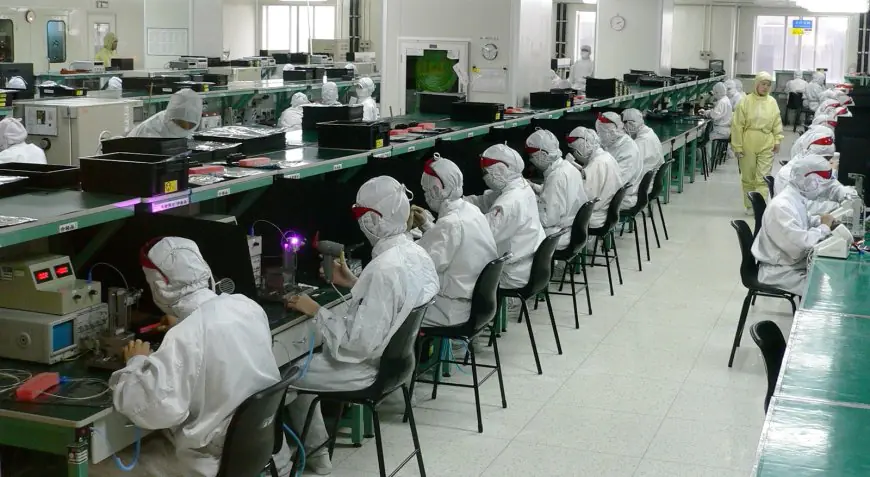
The company that puts the iPhone together wants to be the one that builds the AI boom, too. Foxconn Chairman Young Liu told CNBC on Friday that his company already makes around 40% of the world's AI servers, and that it could reach 50% in a couple of years. Nobody has audited that number. It is Foxconn's own estimate, and the 50% is a goal, not a forecast.


"I think we can grow up to 50 percent." Young Liu, Foxconn chairman, to CNBC
Liu, in an interview with CNBC's Christine Tan, said the share could climb to about 45% next year on the way there. He also said Foxconn's production capacity is fully booked for at least the next year and a half. If that holds, the hardware crunch behind the AI buildout has not eased. It has just moved down the supply chain to the factory floor.
Liu was upbeat about who is buying. He told CNBC that demand has come largely from AI model developers and cloud service providers, while governments and enterprises have yet to fully embrace the technology. In his telling, that leaves a lot of orders still to come. He called demand "quite strong" and expects AI infrastructure to make up 60% to 65% of Foxconn's revenue in three to five years, excluding edge AI devices. Foxconn said in August that its cloud and networking segment, which includes AI servers, made up 51% of second-quarter revenue for the first time above 50%, according to Reuters.
The timing is awkward. AI-sector stocks have been hit hard lately over fears that relentless spending cannot last as borrowing costs climb, Reuters reported. At Foxconn's annual tech showcase in Taipei, Liu told reporters the industry is not in a bubble and that Foxconn expects double-digit growth next year. That is exactly what a company with a full order book would say. It is also the view of a supplier that gets paid whether or not its customers ever earn the money back.
Liu, to his credit, did not hand-wave the risk away.
"Overinvestment will kill the company." Young Liu, Foxconn chairman, to CNBC
He said Foxconn will keep a tight rein on spending even as it expands. The company plans to spend $3 billion to $5 billion a year on AI, though Liu said that could rise depending on how far it pushes vertical integration. Asked what happens if a major customer cuts back, he said weaker demand from one buyer could be offset by growth elsewhere. An industry-wide slowdown, he conceded, would be a much bigger problem for Foxconn and the wider AI supply chain.
That last admission is the interesting part. A company claiming roughly four in ten AI servers is not a bystander to this cycle. It is a pressure gauge for it. Nvidia's CEO has himself been warning that the money is running short, and Liu's own caution echoes the point.
Texas, robots and a hint of OpenAI
Foxconn is also pulling more of the work onshore. Liu told CNBC the company will move further up the supply chain in the US, starting with higher-margin products such as AI server racks and data center equipment, because manufacturing costs are higher there. He said greater scale could eventually bring those costs down. Reuters reported that Foxconn has six factory buildings in Houston making AI servers for Nvidia, and Liu sees a need to expand further.
There was news at the edges, too. Liu said he met OpenAI CEO Sam Altman earlier on Friday and that a collaboration is in the works, with an announcement to come once details are confirmed. Separately, Brand Cheng, chairman of Foxconn unit Foxconn Industrial Internet, told Reuters that more than 10 humanoid robots are already working at its Texas facilities for internal use.
The open question is the one Liu named himself. Foxconn says demand is not in doubt. Whether the customers can keep paying for it is another matter, and no assembler can answer that for them.