










































Intel Blames the AI Memory Crunch as Its Stock Sinks as Much as 29%
Intel shares fell as much as 29% Friday after a weak fourth-quarter forecast, and the company points to AI-driven memory prices squeezing PC demand. Its data center business grew 78% and still could not cover the gap.
Intel delivered a third quarter that beat its own guidance, then watched investors treat it like a disaster. Shares were down as much as 29% as of about 10 a.m. ET Friday, per Reuters, which said the stock was on track for its sharpest one-day decline and for a loss of more than $137 billion in market value. The figure may still move.


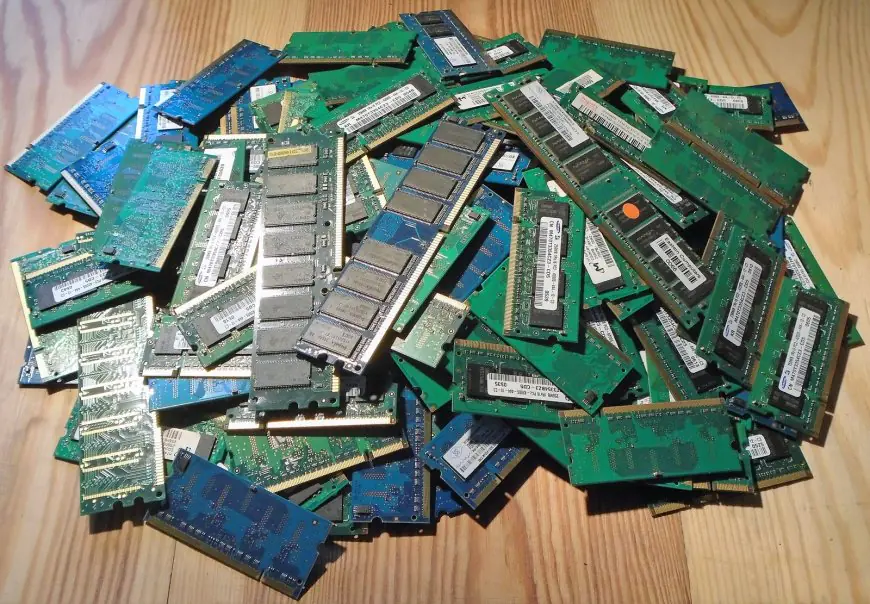
The reason is the part worth chewing on. Intel says the AI boom that is supposed to lift every chipmaker is making memory so expensive that people are buying fewer PCs, and PC chips still pay a big share of Intel's bills. That is Intel's explanation, and analysts have other complaints, but it is a strange twist for a company also selling more server chips to the AI crowd.
The September quarter looked fine on paper. Per Intel's earnings release, revenue hit $16.5 billion, up 21%, with non-GAAP earnings of 52 cents a share. The data center and AI unit jumped 78% to $7.3 billion. Client computing, the PC side, fell 5% to $8.1 billion. Then came the forecast: fourth-quarter revenue of $15 billion to $16 billion and non-GAAP earnings of 25 cents a share, against LSEG averages of $17.07 billion and 43 cents, per Reuters.
"I'm disappointed that we were not able to meet strong customer demand in this quarter. We face near-term challenges, including manufacturing supply shortages, the unprecedented memory crunch, and the resulting softness in PC demand." Lip-Bu Tan, Intel CEO, on the earnings call, as reported by Reuters
CFO David Zinsner said Intel sees "the PC slowdown continuing at least through the first half of next year." Business Insider reported he added that Intel does not expect a sustained recovery "until memory availability improves and pricing begins to normalize." Reuters said suppliers shifting capacity to AI-focused memory are pushing up PC costs. PC chips were roughly half of Intel's third-quarter revenue, and Intel expects that segment to fall more than 20% from the prior quarter.
The server fix has a supply problem
Intel's pitch is that data center demand can pick up the slack. The catch is that Intel cannot make enough. Bank of America analyst Vivek Arya, in a note quoted by CNBC, said data center CPUs are "doing well in a rising agentic tide" but face "a tight supply (substrate) environment." Add a two-week shutdown at its Israel plant after what Tan called "an unfortunate and tragic accident," which Intel expects to cost about $300 million of fourth-quarter revenue, per Business Insider. Zinsner also said Intel does not expect positive cash flow this year, per Reuters.
"More disappointingly, once again company clearly did not see it coming and is still struggling to get their manufacturing footprint aligned with the market (they still have too much PC capacity and not enough server, the latter a year into the current cycle)" Stacy Rasgon, Bernstein analyst, in a note quoted by CNBC
Wall Street moved fast. Bank of America downgraded the stock to neutral, and Bernstein and UBS cut price targets to $75 and $80, CNBC reported. UBS analyst Timothy Arcuri said he sees no relief in sight for memory pricing and supply, partly because server demand for agentic applications keeps growing.
The damage spread. Reuters said AMD, Arm, Qualcomm, Nvidia, Broadcom and Micron fell between 2% and 10%, and server makers Dell, HPE and Super Micro fell 6% to 10%. Hargreaves Lansdown's Matt Britzman called it a "sell first, ask questions later mood," per Reuters.
Here is the angle I keep coming back to. Memory makers are the winners of this cycle, and our report on Samsung's record quarterly profit showed how fat that margin has become. Somebody pays for it. Samsung's own device division lost money last quarter, and now Intel says PC buyers are feeling it too. For some companies, the AI boom is a bill.
Intel's stock had more than doubled this year before the drop, per Reuters, so some of Friday was a reset of expectations. Whether Intel can ship enough Xeon chips in 2027 to cover a long PC slump is a promise, not yet a record. This is not investment advice.