


























Nvidia Now Ships AI Data Centers in a Box as Jensen Huang Warns the Money Is Running Short
Nvidia's new DSX Pod crams seven Vera Rubin racks into a truck-ready container that it says can serve AI in 14 days. Jensen Huang's bigger admission at GTC Berlin was that capital, not chips, is now scarce.
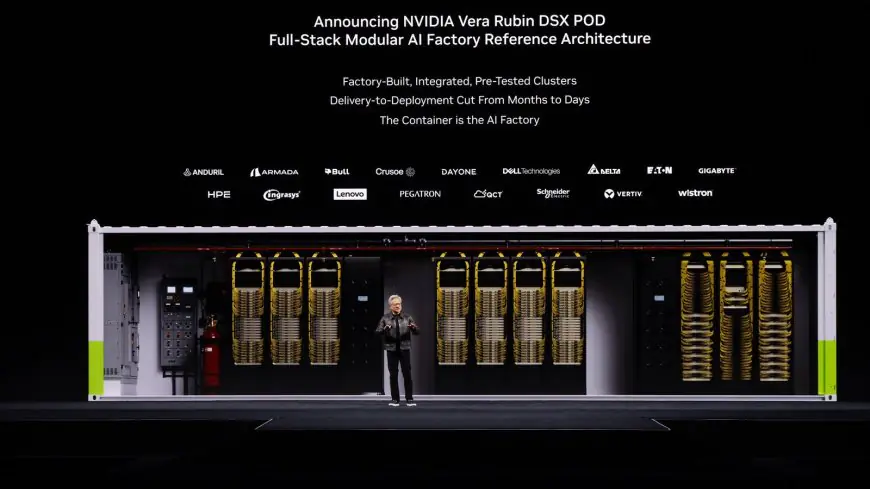
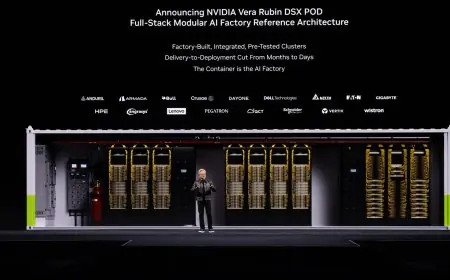
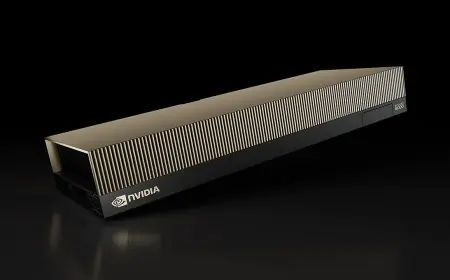
An entire AI data center now fits on the back of a truck. At GTC Berlin on Wednesday, Nvidia unveiled the DSX Pod, a factory-built shipping container that holds seven Vera Rubin NVL72 racks, or 504 GPUs, with the cabling and liquid cooling already wired in. It weighs about 28 tonnes, nearly 62,000 pounds, and Nvidia says it is designed to roll down normal roads.


The pitch is speed. Nvidia claims a DSX Pod can start serving tokens at a prepared site in as little as 14 days, against roughly six months for a conventional build. But the more revealing moment of the week came two days later, when Jensen Huang admitted that the thing holding the AI boom back may no longer be chips at all. It may be money.
"The demand of the capital is much greater than the availability of the capital," Huang told CNBC on Thursday. Asked about getting data centers online faster, he offered a more personal tip: "Try less sleep, which is what I do."
A data center you can order like a forklift
The DSX Pod is a reference design, not a box Nvidia builds itself. Partners do the manufacturing, and the official announcement lists a long roster that includes Foxconn, Dell, HPE, Lenovo, Gigabyte, Quanta, Pegatron, Schneider Electric and Vertiv, with deliveries expected in early 2027. Each unit packs about 10 million components, according to Nvidia's Ian Buck.
"The only thing that has to happen when it gets to the site is it's placed in its location, connected to the rest of the other containers, and validated through final burning and testing." Ian Buck, Nvidia
That is the clever part. Onsite construction is slow and error prone. Moving the messy work into a factory turns a building project into a delivery. Huang framed it bluntly in Nvidia's statement: "An AI factory creates value when it starts producing tokens," and not, in his telling, a day before.
The fine print matters, though. Nvidia's own FAQ concedes the design does not eliminate onsite work. Customers still need a prepared site with power, facility water, cooling and network connections already in place, which are often the real bottleneck. A two week install is only two weeks if the grid hookup is finished first.
Nvidia also gave no price. Analysts cited by CNBC estimate that a single Vera Rubin rack can cost more than $7 million, which by simple math puts seven of them north of $49 million before the container, cooling or networking. Nvidia has confirmed none of it.
And that is where the capital problem bites. Huang told the Berlin audience that a 1 gigawatt data center costs about $50 billion. Goldman Sachs estimates AI related capital spending could reach about $7.6 trillion from 2026 through 2031. Huang himself has said what Nvidia sells into each gigawatt has climbed from about $18 billion to "$40-plus billion" and that he expects it "to keep going up."
"There's just so much demand across so many sectors of AI, there's a scarcity of capital." Jensen Huang, Nvidia CEO
The market was already nervous. On the final day of the conference CoreWeave fell 10% and Nebius dropped 7%, CNBC reported, extending a slide in neocloud stocks driven by worries about heavy borrowing. Huang, whose company holds sizable stakes in many of these firms, insisted that "the demand for the neo clouds is off the charts" and that the funding gap is "going to get solved." One AI infrastructure financing executive told CNBC that "very soon capital will become the bottleneck."
Read together, the two stories say something awkward. The DSX Pod shrinks the time it takes to turn money into compute. It cannot conjure the money. A faster box helps the buyers who already have the cash. For the heavily leveraged neoclouds that make up a big slice of Nvidia's customer base, the question is no longer how quickly they can plug in, but who will finance the next container.
The Berlin show capped a European tour that also put Nvidia at the center of Germany's push for a major AI deal. Huang, unsurprisingly, did not stop to sleep. He headed straight to Kazakhstan.