



























Nvidia and Mira Murati are building a new era of human collaborative AI
Nvidia has announced a massive multi-year partnership and significant investment in Thinking Machines Lab, the new venture founded by former OpenAI CTO Mira Murati, securing a staggering one-gigawatt compute deal to develop next-generation customizable AI.
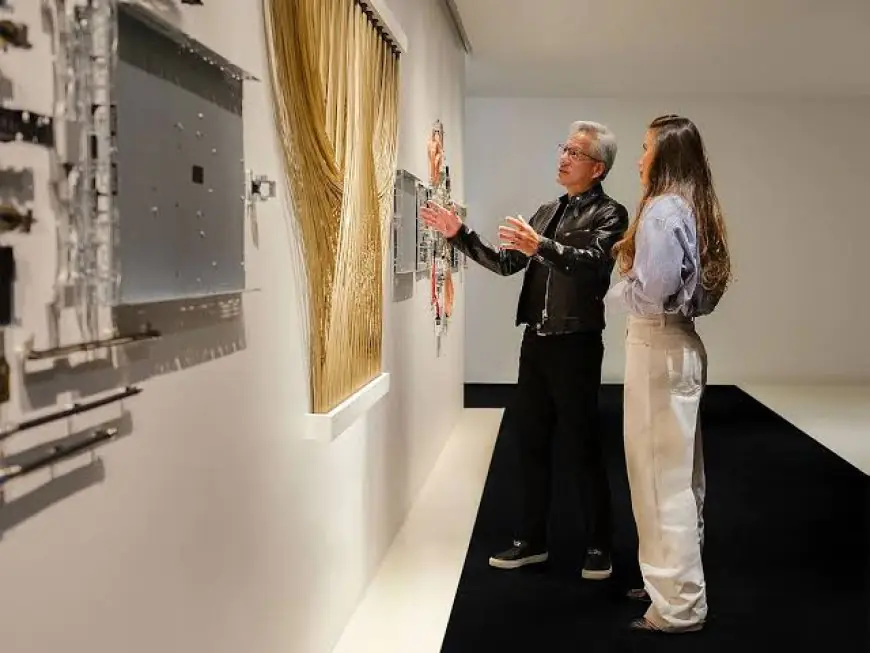


The landscape of artificial intelligence is witnessing a historic realignment as the industry’s hardware king and one of its most celebrated software visionaries join forces. Nvidia has officially confirmed a "significant investment" and a multi-year strategic partnership with Thinking Machines Lab, the high-profile startup founded by former OpenAI Chief Technology Officer Mira Murati. The deal centers on a jaw-dropping commitment to deploy at least one gigawatt of Nvidia’s next-generation "Vera Rubin" computing systems, a scale of infrastructure that effectively cements Murati’s lab as a primary contender in the global race for frontier intelligence.
For Murati, who oversaw the launch of era-defining tools like ChatGPT and DALL-E, the partnership represents a decisive rebuttal to recent skepticism. Following a series of high-profile departures in early 2026—including co-founders rejoining OpenAI—the market questioned whether Thinking Machines could maintain its momentum. This alliance with Nvidia provides the answer: in 2026, compute is the ultimate form of credibility. By securing a gigawatt of power—enough to run a mid-sized city—Thinking Machines Lab has bypassed the "startup struggle" and moved directly into the weight class of tech titans.
The shift from autonomous agents to collaborative partners
While many labs are racing toward Artificial General Intelligence (AGI) designed to operate independently, Thinking Machines Lab is charting a different course. Murati has consistently framed her company’s mission around "human-collaborative AI." The goal is not to build a machine that replaces the human worker, but one that functions as a highly adaptable extension of human agency. This vision is built on the belief that AI should be understandable, transparent, and, most importantly, customizable by the end-user.
The lab’s first product, an API called "Tinker" launched in late 2025, provided an early glimpse into this philosophy. Tinker allows developers to fine-tune open-source models with surgical precision, reducing the cost and complexity of customization. With the new Nvidia partnership, this technology will be optimized at the silicon level. The two companies plan to co-design training and serving systems specifically for Nvidia architectures, ensuring that the software and hardware are perfectly harmonized to support real-time human interaction.
Strategic implications of the one gigawatt compute deal
The scale of this agreement cannot be overstated. Nvidia CEO Jensen Huang has previously noted that a single gigawatt of AI data center capacity can cost upwards of $50 billion to construct. For a startup that is barely a year old to command this level of resource is unprecedented. It highlights Nvidia’s ongoing strategy of "circular investment"—reinvesting its record-breaking profits back into its most promising customers to ensure a long-term ecosystem of demand for its "Vera Rubin" chips.
- Hardware Superiority: The Vera Rubin platform is designed for the trillion-parameter models of tomorrow, offering a massive leap in energy efficiency and throughput.
- Talent Magnetism: Despite the recent departures of Barret Zoph and Luke Metz, Thinking Machines has grown to over 120 employees, drawing elite talent from Google, Meta, and Mistral.
- Independence: By securing independent funding and infrastructure, Murati reportedly turned down a massive acquisition offer from Meta, choosing instead to remain a neutral platform for the wider scientific community.
Industry analysts suggest that this partnership may be the last of its kind before the market enters a period of consolidation. As the "Big Five" tech companies continue to poach talent and secure exclusive chip deals, the window for independent labs to reach "frontier scale" is rapidly closing. More details on the technical specifications of the Vera Rubin architecture can be explored via Nvidia’s official press portal, while financial context regarding Murati’s $2 billion seed round is available at Bloomberg.
Building a legacy beyond the chatbot era
Ultimately, the union of Nvidia and Thinking Machines Lab signals the end of the "simple chatbot" era. We are moving into a phase where AI is expected to possess multimodal reasoning, physical-world awareness, and the ability to work alongside humans in high-stakes environments like medicine and engineering. Murati’s gamble is that people don’t want a digital master; they want a digital partner they can shape and control.
As the first Vera Rubin systems begin their deployment in early 2027, all eyes will be on what Thinking Machines Lab produces. With more compute power than many nation-states and a leadership team that literally wrote the book on modern AI, the stakes could not be higher. Murati isn't just building a company; she is attempting to rewrite the social contract between humans and the machines they create.