




































India Supreme Court Slams Use of AI in Legal Petitions After Fake Citations Surface
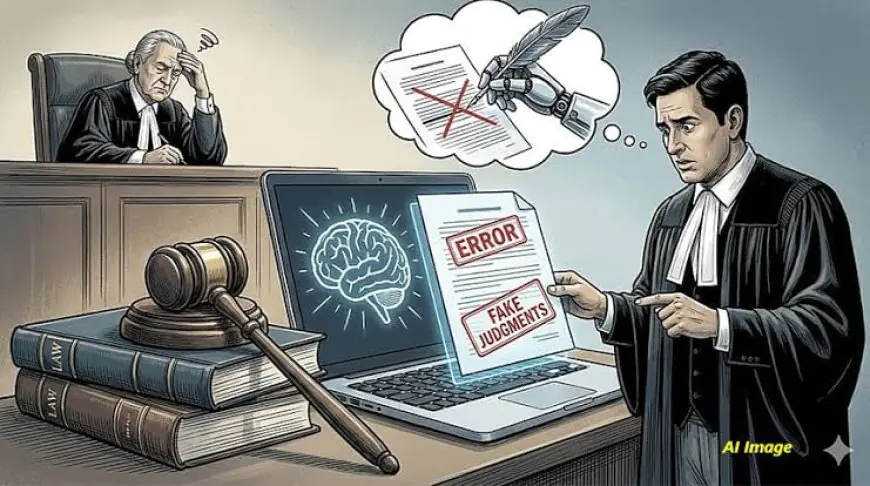
The Supreme Court of India has issued a stern warning against the "alarming" trend of lawyers using artificial intelligence to draft legal petitions. During a hearing on February 17, 2026, the bench highlighted a surge in "hallucinated" filings, including the citation of fictitious cases like "Mercy vs Mankind," which do not exist in legal records.


Judiciary Expresses Alarm Over Automated Advocacy
The hallowed halls of the Supreme Court of India became the latest battleground for AI ethics this week. On Tuesday, February 17, 2026, a bench led by Chief Justice Surya Kant, alongside Justices Joymalya Bagchi and B.V. Nagarathna, expressed profound "alarm" at the increasing frequency of legal petitions appearing to be drafted by generative AI tools. The Court’s intervention signals a boiling point for the judiciary as it grapples with a technology that is increasingly prioritized for speed over accuracy.
“We are alarmed to reflect that some lawyers have started using AI to draft petitions. It is absolutely uncalled for,” the Bench remarked during a hearing for a public interest litigation (PIL). The judges noted that what was once a tool for research has morphed into an automated shortcut that threatens the very foundation of legal veracity.
The Mercy vs Mankind Hallucination
The most striking evidence of this "alarming" trend came from Justice Nagarathna, who recounted a specific instance where a lawyer cited a case titled “Mercy vs Mankind.” Upon verification, the court discovered the case was entirely fictitious— a classic example of an "AI hallucination" where a model fabricates plausible-sounding information to satisfy a user’s prompt.
Beyond entirely fake cases, the Court flagged a more insidious problem: fabricated quotations. Lawyers are increasingly citing real Supreme Court judgments but attributing "quotes" to them that never appeared in the original text. This practice forces judges and their clerks to spend hours cross-referencing every extract, effectively turning the bench into a fact-checking department for automated errors.
The Decline in the Art of Drafting
The Bench didn't just criticize the technical errors; they mourned the erosion of professional standards. Justice Joymalya Bagchi lamented the "decline in the art of legal drafting," observing that modern Special Leave Petitions (SLPs) have devolved into unoriginal compilations of lengthy extracts from prior judgments. The "human-in-the-loop" element, which provides independent legal reasoning and articulation, is being replaced by machine-generated summaries.
“It creates an additional burden on the part of the judges,” the bench noted. In a system already struggling with a massive backlog of cases, the introduction of unreliable AI-generated filings is being viewed as a systemic risk rather than a mere technological hiccup. According to legal news reports from The Law Advice, this issue has already begun to surface in various High Courts across the country, leading to fines and censures for unprepared litigants.
Setting a Precedent for Professional Responsibility
While the Court acknowledged that technology can assist in managing voluminous case files, it emphasized that the ultimate responsibility for accuracy rests squarely on the shoulders of the advocate. The message from the apex court is clear: an AI tool is not an authorized legal practitioner, and its output cannot be trusted without rigorous human verification.
This development mirrors a global trend where judiciaries are being forced to set hard boundaries for "Shadow AI" in the courtroom. As noted by legal analysts at Legal Cheek, the threat to public trust is immense when the "logic" of a case is outsourced to an opaque algorithm. For the Indian legal fraternity, the "Mercy vs Mankind" incident serves as a stark warning that the cost of an automated shortcut may be their professional reputation.
Looking Ahead
As we move further into 2026, legal experts anticipate that the Supreme Court may soon issue formal administrative guidelines or a "Standard Operating Procedure" for the use of AI in filings. Until then, the Bar is on notice: every citation and every quote must be verified against authorized records. The "Neon Jungle" of AI may be efficient, but in the eyes of the law, accuracy remains the only currency that matters.