









































Galgotias University Faces Backlash Over Claims of ‘Inventing’ Chinese Robotic Dog at Delhi AI Summit
Galgotias University has come under intense social media scrutiny following the India AI Impact Summit 2026 in New Delhi. Critics and tech enthusiasts allege the institution misrepresented a commercially available Chinese robotic dog—the Unitree Go2—as an original innovation within its touted ₹350 crore AI ecosystem. While the university has since issued a clarification, the incident has sparked a wider debate on academic integrity and the distinction between "integrating" versus "innovating" technology.


A "Breakthrough" or a Retail Purchase?
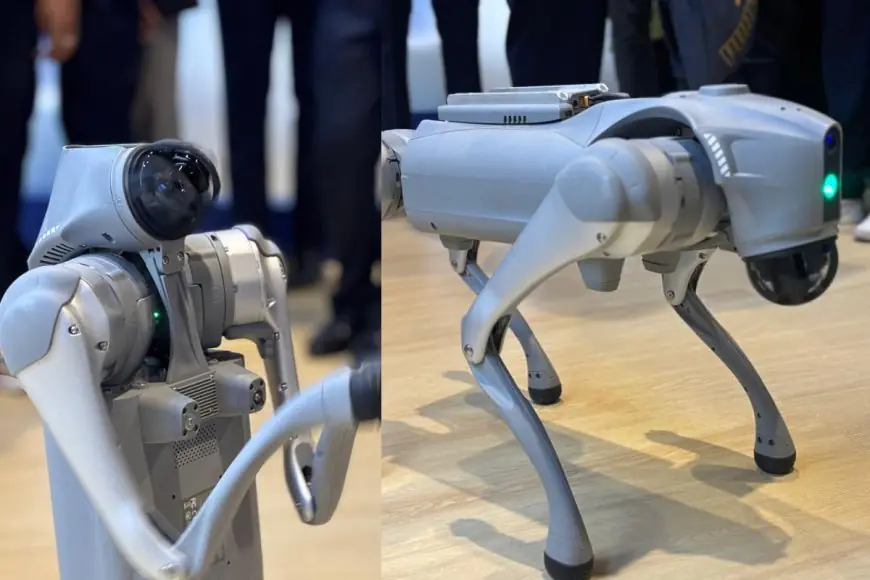
What was intended to be a showcase of India's private academic prowess in artificial intelligence has turned into a viral PR nightmare for Galgotias University. At the India AI Impact Summit 2026, held at Bharat Mandapam in New Delhi, the university’s stall became a focal point not for its research, but for a four-legged robotic dog named "Orion."
The controversy erupted when social media users, led by prominent tech commentators on X (formerly Twitter), pointed out striking similarities between the university’s "innovation" and the Unitree Go2—a mass-produced quadruped robot manufactured by the Chinese firm Unitree Robotics. Available globally for approximately $2,800 (₹2.3–2.5 lakhs), the robot is a common sight in tech labs worldwide, leading to accusations that the university simply rebranded a retail product to justify its claims of a massive ₹350+ crore AI investment.
Viral Video Triggers "Theft" Allegations
The firestorm was fueled by a viral video showing a university representative being interviewed by national media. In the clip, the official discusses the robot’s capabilities—including surveillance and campus navigation—in a way that critics argue suggested the technology was an in-house development.
"They took a commercial robot, slapped a logo on it, and passed it off as a breakthrough in a ₹350 crore ecosystem. This is an embarrassment on the global stage," wrote one viral post that garnered over 20,000 likes within hours.
The optics were further complicated when promotional clips for the summit, featuring high-ranking government officials discussing India's "sovereign AI" capabilities, reportedly included footage of the same robotic dog, leading to claims of a "sham" exhibit that misled both the public and policymakers.
The University's Defense: Integration, Not Invention
Following the backlash, Galgotias University issued a clarification to distance itself from the "theft" narrative. According to university officials, there was never an explicit claim that they manufactured the hardware. Instead, they maintained that the robot was acquired from a global partner to serve as a learning and testing platform for students to develop their own software layers and AI "skills."
The university's CEO, Dr. Dhruv Galgotia, emphasized that the ₹350 crore figure refers to a comprehensive AI ecosystem, which includes:
- Supercomputing Infrastructure: High-end NVIDIA-powered clusters for deep learning.
- Specialized Labs: A Semiconductor Research Lab and a Drone Intelligence Lab.
- Incubation Centers: GICRISE, which supports student-led AI startups.
Despite this, the tech community remains skeptical. Critics argue that at a high-level summit meant to showcase original Indian innovation, presenting a "box-bought" product without clear attribution to the original manufacturer is a breach of professional and academic ethics.
The Credibility Gap in the AI Gold Rush
The Galgotias incident highlights a growing problem in the global "AI Gold Rush": the credibility gap. As institutions race to secure funding and prestige, the line between genuine R&D and clever marketing often blurs.
Analysts suggest that this controversy may serve as a wake-up call for summit organizers to implement stricter vetting processes for exhibitors. As the India AI Impact Summit 2026 continues, the shadow of "Orion" serves as a reminder that in the age of instant internet fact-checking, transparency is just as important as technology.