











































AI Backlash Intensifies as Governments, Workers and Investors Push Back
Resistance to artificial intelligence is growing worldwide as policymakers, labor groups, and investors raise concerns over AI's impact on jobs, infrastructure, energy consumption, and long-term economic sustainability. The debate is increasingly shaping AI regulation and investment decisions.
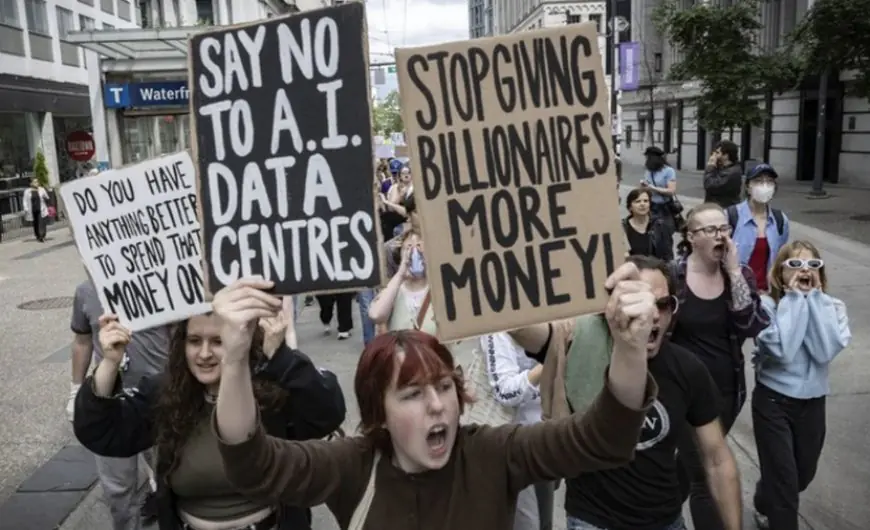
Resistance to artificial intelligence is intensifying across multiple fronts, with local communities blocking data center projects, labor unions demanding worker protections, and investors questioning the sustainability of massive AI spending.


The flashpoint has been data centers, the multi-football field-sized computing facilities that power AI.In the first three months of 2026 alone, local data center opposition blocked or delayed 75 projects worth $130 billion in planned construction — roughly the same number affected in all of 2025.
New York became the first U.S. state to impose a moratorium on new AI data center construction, following a Gallup poll that found more than 70 percent of respondents opposed such projects in their neighborhoods. As Vox explained, "Americans don't know how to fight AI. So they're fighting data centers."
"You don't have to be a weatherman to know which way the wind is blowing." – Bob Dylan, as quoted in a Brookings analysis of AI's political turn
The backlash extends beyond land-use fights. Labor unions are deeply divided over AI's impact. AFL-CIO President Liz Shuler called unregulated AI "the single biggest threat to working people of our lifetime," while construction unions are championing data center projects as a vital source of jobs.
The International Brotherhood of Electrical Workers has urged members to lobby Congress against a data center moratorium. Meanwhile, workers are already organizing: rank-and-file employees of dominant AI companies have formed the Guardrails Alliance, collecting small-dollar donations to push back against industry-funded super PACs like Leading the Future, which launched with $140 million from Silicon Valley luminaries.
Energy constraints are becoming a critical bottleneck. Data center electricity demand is projected to roughly double from 485 TWh in 2025 to 950 TWh in 2030.
The International Energy Agency warns that bottlenecks across energy supply chains and advanced chip manufacturing are tightening, while communities push back against data center projects amid concerns about affordability and environmental impacts.
On the financial front, the Bank for International Settlements has warned that the AI boom could turn to bust, citing "circular financing" and rapidly growing debt loads among hyperscalers. The five largest AI spenders have added about $350 billion in debt over the past five years to fund their expansion.
As the political backlash against AI intensifies, the debate has become a referendum on democratic accountability itself. The core question, as The Economist distilled it, is this: "Five men control AI. Who controls them?" That is now a question for voters, workers, communities, and markets to answer.