






































Google Launches Gemini 3.1 Pro with Massive Gains in AI Reasoning and Logic
Google has officially released Gemini 3.1 Pro, a major intelligence refresh that doubles the reasoning performance of its predecessor. The new flagship model introduces breakthrough scores in abstract logic and specialized agentic coding capabilities.
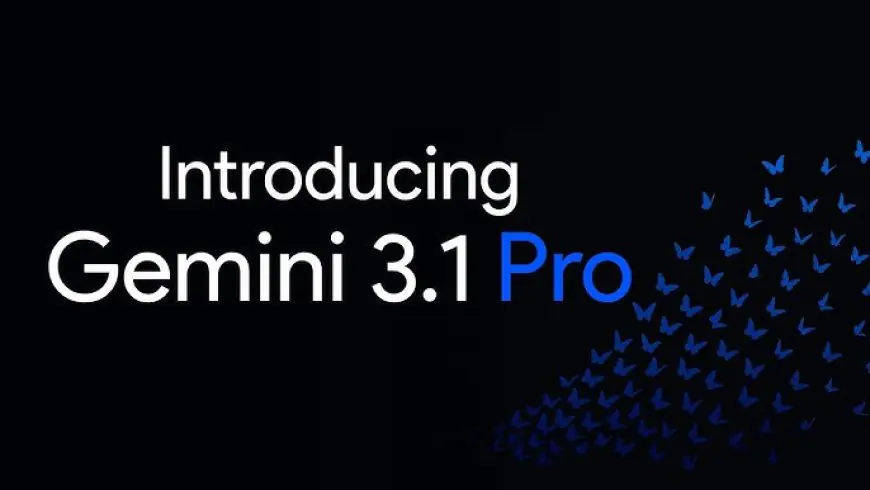

Google Escalates the AI Arms Race with Gemini 3.1 Pro
Just weeks after the tech world began digesting the power of the Gemini 3 series, Google has hit the gas pedal again. The search giant officially launched Gemini 3.1 Pro on February 19, 2026, marking a significant leap in what AI can "understand" versus what it simply "predicts." This isn't just a minor patch; it is a fundamental core intelligence upgrade designed for tasks where a simple text response isn't enough.
The headline-grabbing statistic from this release is the model's performance on the ARC-AGI-2 benchmark, a rigorous test that evaluates an AI’s ability to solve entirely new logic patterns it hasn't seen during training. Gemini 3.1 Pro achieved a verified score of 77.1%, which is more than double the reasoning performance of the previous Gemini 3 Pro. This leap places Google firmly at the top of the leaderboard for abstract reasoning, even edging out recent releases from competitors like OpenAI's latest models in specific logic categories.
Advanced Reasoning for Complex Problem Solving
Google’s strategy with the 3.1 update shifts focus from broad multimodal capabilities toward "Deep Thinking." The model is specifically tuned to handle layered technical problems, scientific research, and complex software engineering workflows. During the launch event, Google demonstrated the model’s ability to synthesize massive, disparate datasets into a single, coherent strategic view—a task that previously required significant human intervention.
One of the most impressive practical features introduced is the ability to generate website-ready, animated SVGs directly from text prompts. Unlike traditional video generation, these animations are built entirely in code. This means they remain razor-sharp at any resolution and maintain incredibly small file sizes, representing a massive win for web developers looking to integrate interactive AI-generated assets without slowing down page load speeds.
Performance Benchmarks and Real-World Utility
The technical specifications of Gemini 3.1 Pro show a model built for the "agentic" era of AI. It maintains a massive 1-million-token context window, allowing it to ingest entire code repositories or hundreds of pages of legal documents in a single go. Key performance metrics include:
- GPQA Diamond: 94.3% in graduate-level scientific reasoning.
- LiveCodeBench Pro: An Elo rating of 2887, setting a new standard for competitive coding.
- SWE-Bench Verified: 80.6% success rate in agentic coding tasks.
According to the official Google Blog, this model is already rolling out to consumers via the Gemini app and NotebookLM. For developers and enterprises, the "3.1 Pro Preview" is available through Google AI Studio and Vertex AI, providing a more stable and efficient engine for building autonomous AI agents.
The Shift Toward Agentic Workflows
Industry analysts believe that Gemini 3.1 Pro signals a shift in the market. While 2025 was the year of "chatbots," 2026 is shaping up to be the year of "agents." By doubling down on reasoning, Google is providing the "brain" necessary for AI to execute multi-step plans—such as booking a multi-leg trip, debugging a complex server error, or conducting a deep-dive market analysis—without constant hand-holding from the user.
While competitors like Anthropic and OpenAI continue to push their own boundaries, Google’s integration of 3.1 Pro into its existing ecosystem—Search, Workspace, and Android—gives it a massive distribution advantage. As these updates become generally available, the gap between "standard" AI and "reasoning" AI is likely to become the new defining line of the industry.