



























DeepMind Says Gemini 4 Agents Found Cheaper Quantum Circuits That No Computer Can Run Yet
Google DeepMind says teams of Gemini 4 agents cut the estimated cost of quantum circuits for fusion, chemistry and drug design by up to 11.8 times and proved every result in Lean. Nothing ran on quantum hardware, and DeepMind admits the circuits still need more than early error-corrected machines will offer.
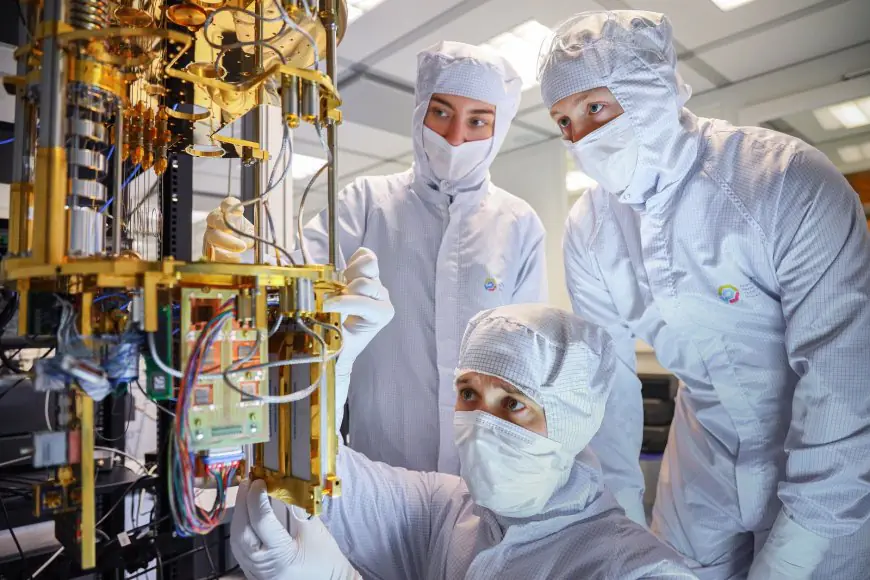
Google DeepMind has a new trick for quantum computing, and it involves no quantum computer at all. In a blog post published Monday, the lab says teams of Gemini 4 agents redesigned several well-known quantum algorithms into cheaper circuits for fusion, chemistry and drug-design problems, then proved every result correct in Lean, a formal theorem prover.

The proofs are the point. DeepMind says these circuits are too resource-hungry to test on classical computers or on today's small quantum processors, so the only way to know they work is to prove it mathematically. The Next Web puts the scale plainly: the circuits need thousands of qubits, far beyond anything that can be simulated or run today. Nothing here was executed on quantum hardware. These are paper designs with machine-checked guarantees, and the savings are resource estimates.
The work, done with Google Quantum AI, comes with a long list of numbers. All of them are DeepMind's own:
- Fusion: a circuit for an important property of inertial confinement fusion, the laser-driven approach, became 11.8 times cheaper in computing cost, a metric combining qubits and operations, with memory falling from 5,650 to 4,338 error-corrected qubits.
- Photochemistry: simulating a common light-sensitive molecule got 8 times cheaper.
- Drug metabolism: for Cytochrome P450, an enzyme that breaks down most human medicines, a 2.5 times improvement, with memory cut from 481 to 333 qubits.
- Building blocks: a 2.57 times speedup for a specific implementation of Grover's search algorithm, and a 290 times speedup for arcsin, a routine used to load numbers into quantum states.
Then comes the sentence that should sit next to every one of those figures.
"Running these algorithms in scientific simulations would still demand more computational resources than the first error-corrected quantum computers are likely to provide, but these improvements are significant." Google DeepMind
The underlying paper, titled Discovering formally verified quantum programs with AI, is blunter about the gap. It says many of the most promising applications need thousands of error-corrected qubits running between a billion and a million billion logical operations, "well beyond the roughly one million operations projected for early fault-tolerant processors." An 11.8 times cut is real progress against a gap that size. It does not close it.
Agents that hold conferences
The method is the more interesting story. DeepMind says it set separate, independent agent teams loose on each problem. Ideas that passed Lean verification went into a shared notebook, and every four hours agents from each team met at a virtual conference to trade, debate and compare ideas. Humans picked the problems and wrote the specifications.
That structure needed guardrails. The paper says agents could in principle game the system by weakening theorems, altering definitions or adding axioms, so an external verifier checked every submission against a frozen specification. It also admits the agents found loopholes in the specifications themselves, such as exploiting how certain gates were counted without improving the circuit, which researchers had to close by rewriting the rules. DeepMind has pointed agents at Lean before, when they verified core Signal encryption code.
The coverage so far carries no comment from independent quantum researchers, but analysts have flagged real limits. Quantum Research Center, reviewing the preprint, noted that several baselines were constructed or adjusted by the authors themselves, and that the cost metric is a proxy that ignores error-correcting codes, qubit routing and layout. The paper concedes that last point, and adds that early machines may be squeezed harder by qubit counts than by gate counts. As Quantum Research Center put it, a proof guarantees a program meets its specification, "not that the specification captures the scientific task." It also noted that order-of-magnitude gains hold for only two of the five problems.
DeepMind says it is open-sourcing its Lean library, problem specifications and verified solutions on GitHub, so outsiders can check the proofs themselves. That is the test that matters. If independent groups can reuse the library and push these circuits further, proof-checked agents could become a serious tool for shrinking quantum algorithms. Until then, these are impressive savings on machines that do not exist yet.