







































How AI Killed Stack Overflow and Changed Coding Forever
The legendary developer forum Stack Overflow has seen an 80 percent drop in activity as engineers abandon human-led Q&A for the instant gratification of AI coding assistants and integrated IDE agents.


The Empty Halls of the Global Village
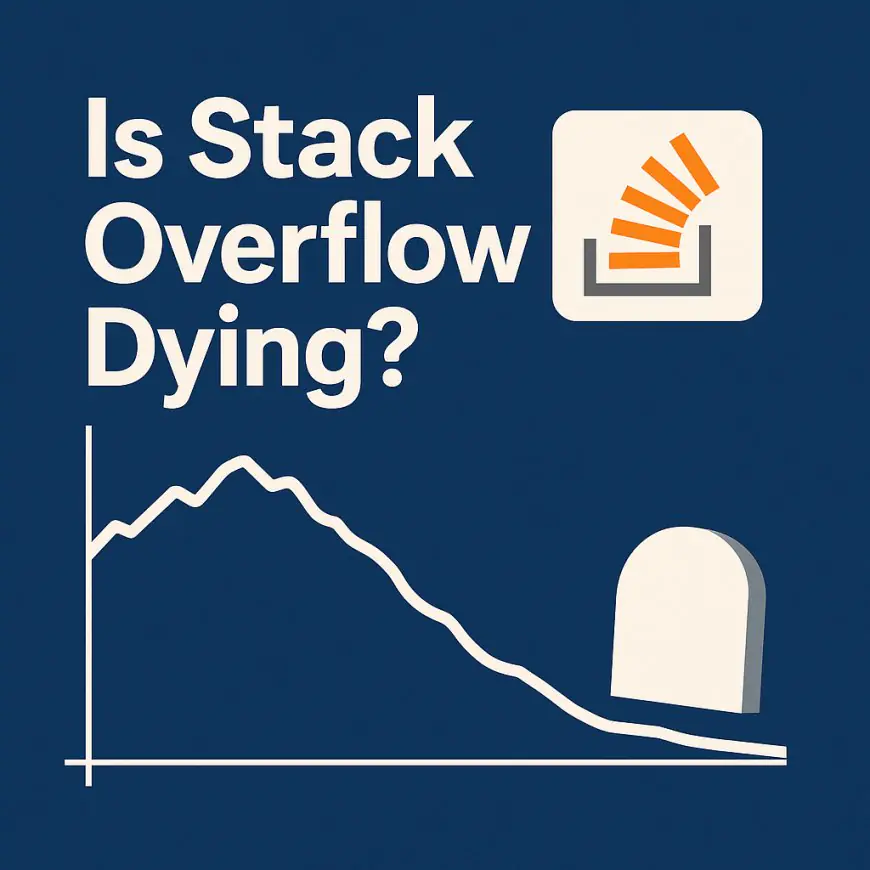
For nearly two decades, Stack Overflow was the pulse of the software engineering world. If you were a developer, your day likely involved a cycle of getting stuck, searching a cryptic error message on Google, and finding your salvation in a highly-upvoted thread. But as we move into 2026, the statistics tell a somber story. Recent data reveals that monthly question volume on the platform has plummeted by nearly 80 percent from its peak, signaling that the "Stack Overflow era" has officially come to an end.
The culprit, of course, is the rapid rise of Agentic AI. Why would a developer wait three hours for a human moderator to mark their question as a "duplicate" when a local AI agent can provide a tailored, context-aware solution in three seconds? The shift is not just about speed; it is about a fundamental change in how humans interact with technical knowledge. We have moved from a search-and-verify model to a generation-and-debug model.
The IDE is the New Search Engine
The real "killer" of the traditional forum wasn't just a chatbot; it was the integration of intelligence directly into the code editor. Tools like DevClass report that the vast majority of developers now use assistants like GitHub Copilot or Cursor as their primary interface for problem-solving. These tools don't just know the language; they know your specific project structure, your dependencies, and your unique coding style.
This "Vibe Coding" movement has removed the friction of leaving the development environment. When the answer to a complex bug is suggested as you type, the incentive to participate in a public community vanishes. The once-vibrant ecosystem of upvotes and reputations has been replaced by a private, silicon-based conversation. For many, the social pressure of asking a "dumb question" on Stack Overflow—and getting roasted for it by gatekeeping moderators—is a memory they are happy to leave behind.
The Irony of the Training Data
There is a poetic, if somewhat tragic, irony in this collapse. The very Large Language Models (LLMs) that are currently making Stack Overflow irrelevant were built on the backs of its contributors. The millions of human-verified answers provided for free by the community over the last 15 years served as the high-quality training data that enabled AI to become so proficient at coding. In essence, the community unknowingly built its own replacement.
Recognizing this, Stack Overflow has pivotally shifted its business model. Instead of relying solely on ad revenue from human traffic, the company has entered the "Knowledge Solutions" market. By partnering with tech giants like OpenAI and Google Cloud, Stack Overflow is now licensing its vast corpus of data to power the next generation of AI. According to the Stack Overflow Blog, this strategic pivot helped the company achieve revenue growth in 2025, even as its public participation numbers cratered.
The Future of Human Verified Knowledge
While the forum as we knew it is dying, a new and perhaps more vital role is emerging for human experts. As AI-generated code floods the internet, the problem of "model collapse" looms. If AI begins training mostly on AI-generated content, the quality of its output will inevitably degrade. This creates a "trust gap" that only human verification can bridge.
In 2026, Stack Overflow is attempting to reposition itself as the "Verification Layer" of the internet. Developers are finding that while AI is great at writing boilerplate, it frequently struggles with architectural nuances or the latest security vulnerabilities. About 35 percent of developers now report visiting the platform specifically to verify or fix "hallucinated" code provided by their AI assistants. The site may no longer be the first place we go to find an answer, but it remains the final court of appeal when the machines get it wrong.
The death of Stack Overflow’s community is a reminder that in the age of automation, convenience often triumphs over connection. However, as the digital world becomes increasingly filled with "almost-right" AI code, the value of a human-verified "canonical" answer has never been higher. We might not post as much, but we still need a source of truth.