





























The Cloud Killer? World’s Smallest Pocket AI Supercomputer Runs 120B LLMs Locally
A U.S. deep-tech startup has unveiled the Tiiny AI Pocket Lab, a palm-sized supercomputer capable of running massive 120B parameter LLMs entirely on-device. Discover the future of private, portable edge AI.
For years, the narrative surrounding Artificial Intelligence has been defined by massive scale: sprawling data centers, gigawatts of energy consumption, and an incessant reliance on the cloud. Today, that narrative just fractured.

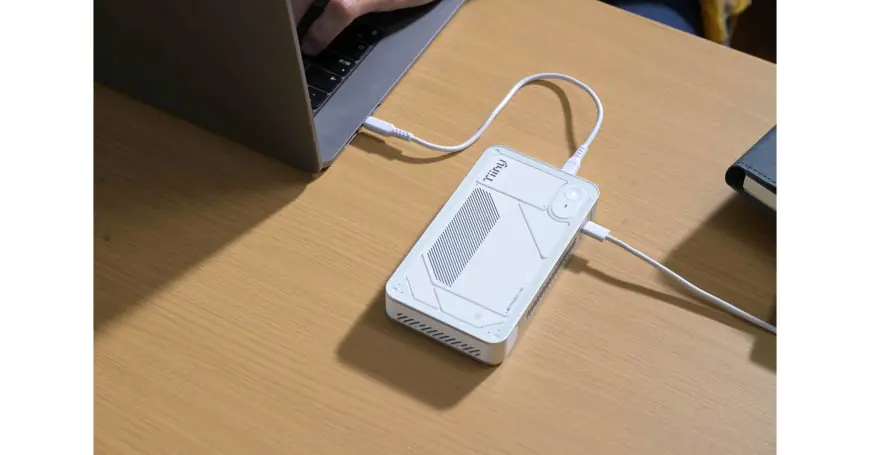
A U.S.-based deep-tech startup has emerged from stealth to unveil the Tiiny AI Pocket Lab, a device that defies current engineering logic. It is a palm-sized AI supercomputer, scarcely larger than a stack of credit cards, yet it possesses the computational density to run a 120 billion-parameter large language model (LLM) entirely locally.
This is not a remote access terminal. There is no Wi-Fi tethering to an AWS server farm. The inference happens right in your hand.
The unveiling marks a potential watershed moment for edge AI computing, signaling a future where enterprise-grade intelligence is untethered from the internet, offering unprecedented speed and, crucially, absolute data privacy.
The Engineering Marvel: Shrinking the Data Center
Running a 120B parameter model—roughly equivalent in complexity to early versions of GPT-3—typically requires multiple high-end data center GPUs (like Nvidia H100s) running in parallel. Fitting that capability into a pocketable form factor is a staggering achievement in silicon architecture and model optimization.
While the startup has remained tight-lipped about the exact specifications of the proprietary silicon powering the Tiiny AI Pocket Lab, industry analysts speculate the breakthrough involves a combination of ultra-efficient, specialized Tensor Processing Units (TPUs) and extreme model quantization techniques that shrink LLMs without catastrophic performance loss.
"We are entering the post-cloud era for personal AI," said the startup’s CEO during the unveiling. "The goal isn't just portability; it's about democratizing access to unbridled intelligence without sacrificing sovereignty over your data."
The Death of Latency and the Rise of Privacy
Why does on-device AI processing matter? In a word: autonomy.
By severing the connection to the cloud, the Tiiny AI Pocket Lab addresses the two biggest bottlenecks facing current generative AI: latency and privacy.
1. Zero-Latency Response: Cloud-based AI requires sending a prompt to a server hundreds of miles away, processing it, and sending the answer back. This introduces lag. The Pocket Lab processes locally, offering near-instantaneous responses crucial for real-time applications like on-the-fly translation or complex field diagnostics.
2. The Ultimate Privacy Shield: For industries dealing with sensitive IP, medical data, or classified information, cloud AI is a security risk. With on-device processing, your data never leaves the hardware. A field researcher in the Amazon rainforest, a defense contractor in a secure facility, or a doctor in a rural clinic can utilize top-tier AI analysis without exposing data to third-party servers.
The New Frontier of "Edge AI"
The Tiiny AI Pocket Lab is more than just a powerful gadget; it is a harbinger of the Edge AI revolution.
Until now, "edge AI" usually meant small devices performing simple tasks, like a smart camera identifying a person versus a cat. This new device moves generative AI to the edge.
This development is poised to disrupt several sectors:
Field Research: Scientists can analyze massive datasets in remote locations without satellite internet.
Cybersecurity: Red teamers can carry powerful code-auditing LLMs into air-gapped environments.
Creative Professionals: Writers and coders can utilize massive generative assistance tools completely offline on airplanes or remote cabins.
While pricing and mass availability dates for the Tiiny AI Pocket Lab have yet to be finalized, its mere existence proves that the centralization of AI power is not inevitable. The supercomputer is no longer just in the server room; it’s in your pocket.