







































How Agentic AI is the Ultimate Shield Against Nigeria’s Tax Act 2025 Traps
As the Nigeria Tax Act 2025 officially commences on January 1, 2026, taxpayers face a complex new unified fiscal code. This article explores how "Agentic AI" and sophisticated chatbots are becoming essential tools for navigating hidden legal traps, from "artificial transaction" flags to the strict documentation required for tax-free gifts.


A New Fiscal Frontier: The Nigeria Tax Act 2025
The dawn of 2026 marks a historic shift in West Africa’s largest economy. The Nigeria Tax Act 2025 (Act No. 7) has officially commenced, sweeping away decades of fragmented legislation and replacing it with a single, unified fiscal framework. While the law aims to simplify the tax system, it also introduces sophisticated "traps" designed to close loopholes and expand the tax base. For the average individual or business owner, staying compliant while protecting wealth has never been more challenging—or more reliant on technology.
Enter Agentic AI. Unlike traditional chatbots that merely answer questions, agentic systems can plan, execute, and verify complex financial workflows. As taxpayers grapple with new graduated rates and the ₦50 Electronic Money Transfer Levy (EMTL), these digital agents are proving to be the ultimate shield against avoidable litigation and penalties.
Defusing the "Artificial Transaction" Trap
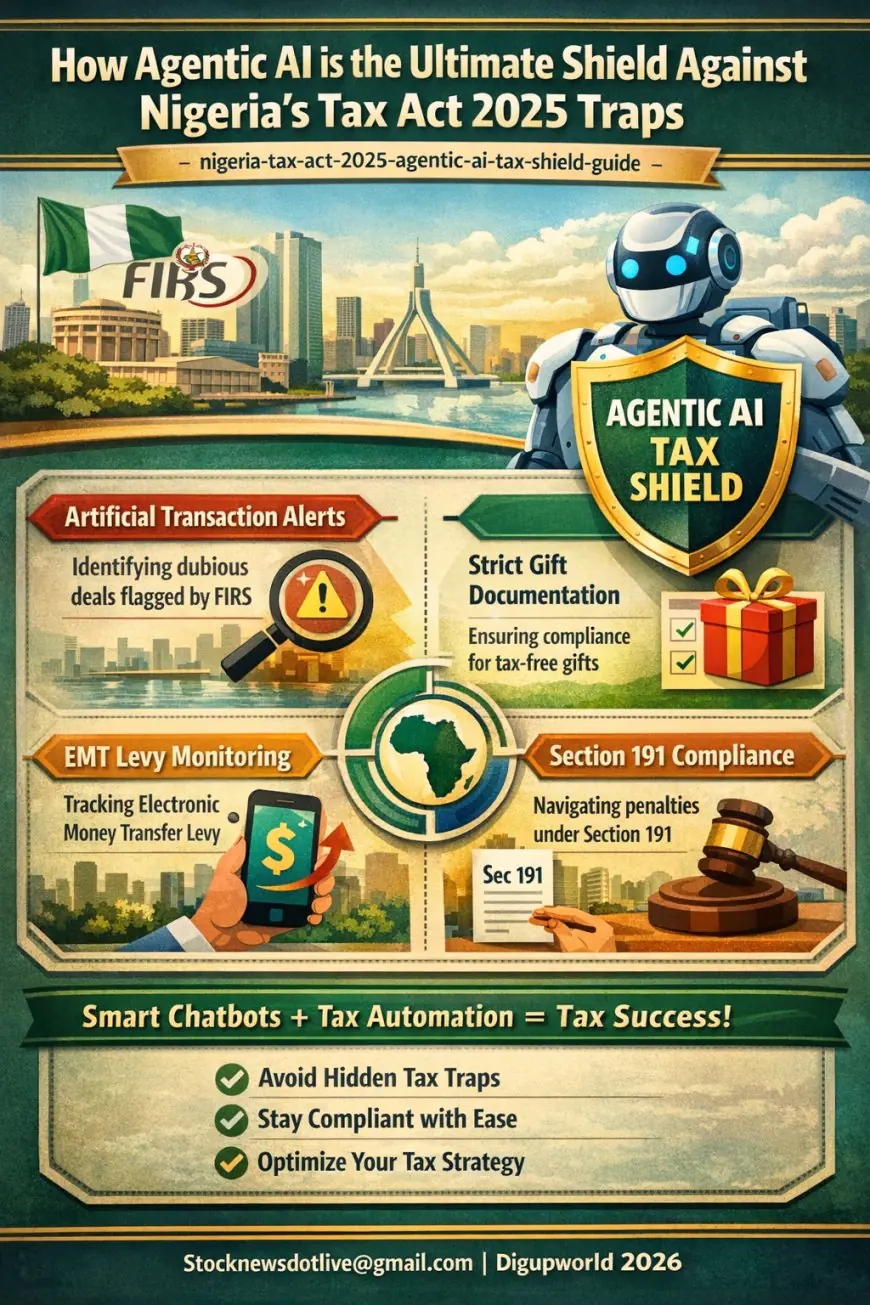
One of the most potent weapons in the Federal Inland Revenue Service (FIRS) arsenal is Section 191, which targets "Artificial Transactions". This section gives tax authorities the power to disregard any transaction they deem fictitious or designed purely to reduce tax liability. For example, trying to reclassify a taxable business grant as a "gift" to avoid the 25% top-tier income tax rate is now a high-risk move.
Agentic AI serves as a pre-audit filter. By analyzing the "substance over form" of a transaction, an AI agent can flag a ₦15 million credit before it hits your account. It can warn you that because the funds originated from a commercial organization rather than a relative, claiming it as a gift without a project-free agreement will likely trigger a Section 191 investigation.
The 30-Day Documentation Race
Under the new law, documentation is no longer just a "best practice"—it is a legal necessity for admissibility. Section 127 states that any unstamped dutiable instrument, such as a Deed of Gift, is generally inadmissible as evidence in court or during a tax dispute. Furthermore, these documents must be stamped within 30 days of execution.
AI chatbots are now being programmed with "agentic" capabilities to manage this timeline. An AI agent can:
- Automatically generate a legally compliant Deed of Gift that explicitly states "no consideration" was received, satisfying the gift criteria of the Act.
- Set automated reminders to ensure the document is stamped at the local Stamp Duties office within the 30-day window.
- Securely store digital copies of stamped receipts to prove the ₦50 EMTL was paid on the underlying transfer.
Navigating EMTL and Graduated Tax Rates
The Act applies a fixed ₦50 levy on electronic transfers of ₦10,000 and above, with very specific exemptions for "intra-bank self-transfers" and salary payments. For high-volume traders, these small charges can add up. Agentic AI can monitor your banking patterns, suggesting which transfers should remain within the same bank to qualify for the intra-bank exemption.
Moreover, with the new graduated income tax rates—ranging from 0% on the first ₦800,000 to 25% on income above ₦50 million—AI agents provide real-time tax liability forecasting. This allows entrepreneurs to make informed decisions about when to take dividends or reinvest profits into priority sectors, which may enjoy five-year tax-free periods under the Act’s incentive schemes. For deeper insights into the economic impact of these changes, the National Bureau of Statistics provides essential data for AI modeling.
The Verdict: Get an AI Tax Manager
The Nigeria Tax Act 2025 is a masterclass in modern fiscal policy, but its complexity is a minefield for the uninformed. While the law allows you to file taxes yourself, the risk of "flagging" for large credits (₦5M for individuals, ₦10M for corporates) is too high to ignore. Leveraging Agentic AI isn't just about efficiency; it's about building a digital paper trail that is 100% dispute-proof. In the era of the unified tax code, your best tax manager might just be an algorithm.