





































Reasons Why DRAM Prices Are Ridiculously High Right Now
The reasons why DRAM prices are ridiculously high right now are due to AI-fueled HBM demand, which is starving the standard DDR4/DDR5 supply, as manufacturers prioritize high-margin AI memory amid fabrication delays and oligopoly pricing.
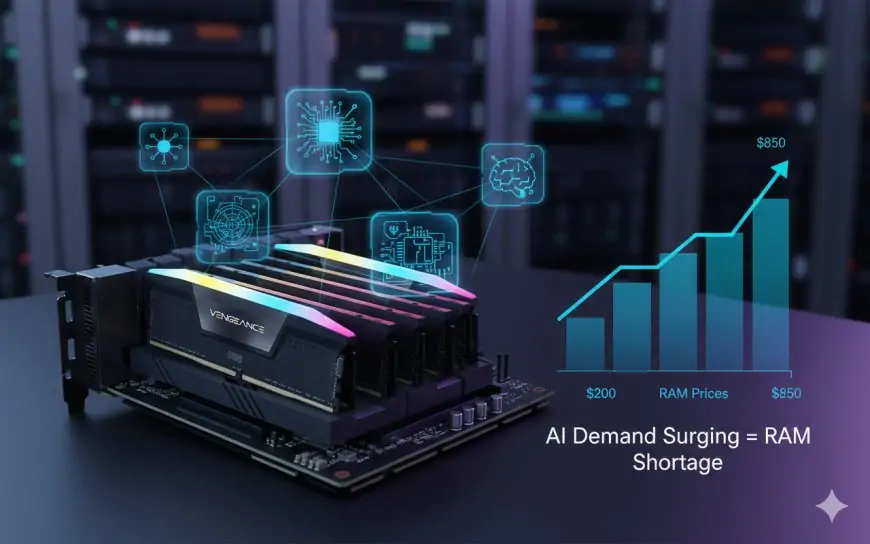
The high price of DRAM (Dynamic Random-Access Memory) in 2026 is driven primarily by a severe supply-demand imbalance fueled by the rapid acceleration of the Artificial Intelligence (AI) boom. This situation is impacting everything from consumer PCs to servers, as manufacturers prioritize high-margin specialized memory over standard modules.


The Core Reason: The AI Boom and Manufacturing Prioritization
The core issue is that global memory demand, particularly from AI data centers, is exceeding the available supply, while manufacturers are strategically shifting production to more expensive, specialized segments, which is more financially rewarding to the company and its investors.
1. Massive AI-Driven Demand for High-End Memory
The training and deployment of large language models and other AI workloads require unprecedented amounts of high-speed memory, which has fundamentally changed the DRAM market dynamic:
- HBM Priority: AI accelerators and high-performance GPUs rely heavily on High Bandwidth Memory (HBM), a specialized, vertically-stacked type of DRAM. This memory offers extremely high margins for manufacturers.
- Production Shift: Major memory producers are reallocating significant portions of their standard DRAM manufacturing capacity to produce HBM instead. Every wafer dedicated to HBM is capacity removed from producing commodity DDR5 or DDR4 RAM.
- Hyperscaler Contracts: Large cloud providers and AI companies are securing massive, long-term supply contracts for HBM and high-density server DRAM, effectively consuming a huge chunk of the total production capacity.
2. Constrained Production of Standard DRAM
The increased focus on HBM naturally leads to a reduced supply of the standard memory modules used in PCs, laptops, and typical servers:
- Capacity Crunch: The reallocation of manufacturing lines has caused a direct shortage of standard DDR5 and DDR4 memory, leading to sharp price increases (in some cases, exceeding 100% year-over-year).
- Slow Fab Expansion: Building new memory fabrication plants (fabs) is a costly process that takes multiple years to bring online. As a result, manufacturers cannot quickly ramp up production to meet the sudden, explosive demand. Supply normalization is not expected before 2027 or 2028 when new capacity finally emerges.
3. Structural Market and Cost Factors
Beyond the AI-driven shift, other factors are contributing to the high pricing and volatility:
- Oligopoly Effect: The DRAM market is dominated by a few major players (Samsung, SK Hynix, and Micron). With strong demand in the high-margin AI sector, the incentive to flood the market with cheap commodity memory is minimal, helping to sustain higher prices.
- Inventory Depletion: Once current stock, which may have been procured at lower prices, is exhausted, all new product shipments will reflect the current, much higher market rates.
- Impact on Related Memory: The shortage is also affecting NAND flash (used in SSDs) and GDDR memory (used in graphics cards), as production capacity tightens across the entire memory industry, pushing up costs for a wide range of electronic devices.
The consensus across the industry is that tight memory supply and high prices for commodity DRAM will persist through 2026, with little expectation of a return to pre-shortage prices until more production capacity specifically for standard memory comes online.